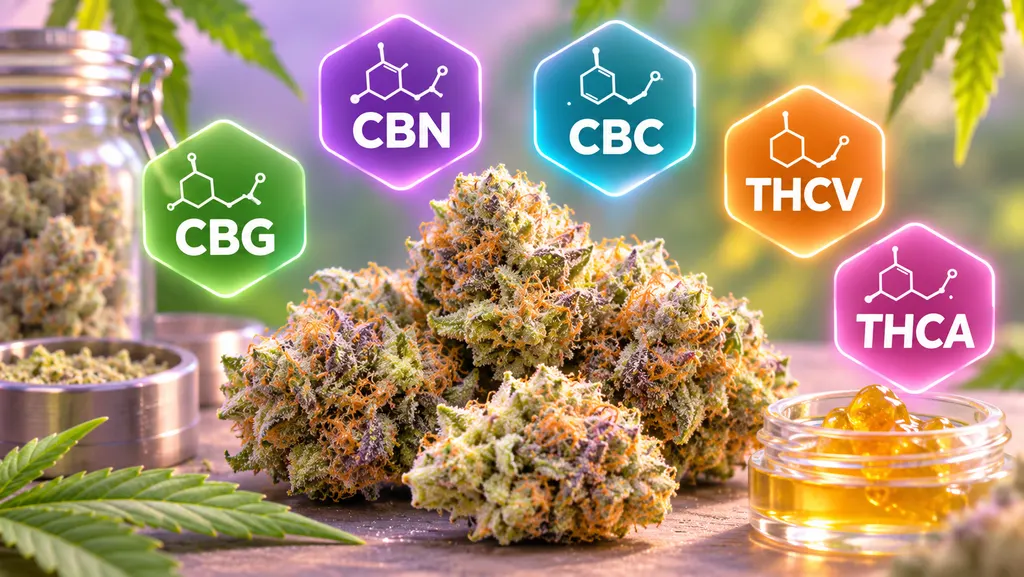
Cannabis makes well over a hundred cannabinoids, and a handful of them (CBG, CBN, CBC, THCV and THCA) now show up in product names. This guide covers where each comes from, how thin the human research still is, what Canadian rules say about cannabinoids that are not delta-9-THC, and why a minor cannabinoid you cannot see on a label may still be in the jar.
What are minor cannabinoids?
Minor cannabinoids are the cannabinoids in cannabis other than THC and CBD. The word minor describes how little of each a typical plant contains. It says nothing about how strong any of them is.
That matters because a cannabinoid can sit at a fraction of a percent and still be treated by a regulator as intoxicating. Cannabinol is exactly that case. "Not listed" in the table only means a molecule is absent from Health Canada's list of intoxicating cannabinoids other than delta-9-THC. It is not a safety rating.
For the two major cannabinoids, see our THCA vs THC guide and our list of high-CBD strains.
| Cannabinoid | Full name | Where it comes from | Listed by Health Canada as intoxicating? |
|---|---|---|---|
| CBG | Cannabigerol | Neutral form of CBGA, the plant's precursor molecule | Not listed |
| CBN | Cannabinol | Mostly a breakdown product of THC as it ages | Yes, by name |
| CBC | Cannabichromene | Third branch made from the same precursor | Not listed |
| THCV | Tetrahydrocannabivarin | A shorter-chain relative of THC | Yes, by name |
| THCA | Tetrahydrocannabinolic acid | The acid form of THC in the living plant | Not listed |
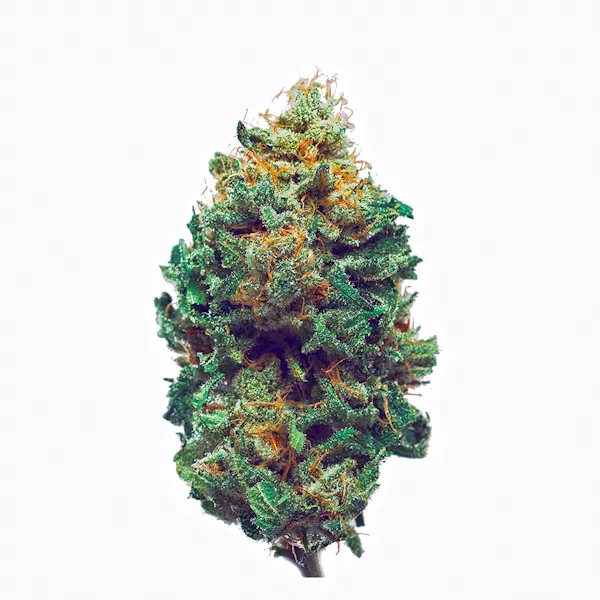
Where do minor cannabinoids come from?
Most of them branch off one precursor. The plant builds cannabigerolic acid (CBGA), then enzymes convert it three ways: into THCA, CBDA and cannabichromenic acid. Whatever is not converted stays behind as CBGA.
A 2021 pharmacology review describes CBGA as "normally found in very low quantities" in cannabis, and says very few strains harbour large concentrations of CBG. High-CBG plants exist because breeders selected for less activity in the converting enzymes, so the plant is stopped partway down the pathway. That is why the slogan "mother cannabinoid" is only half right: the acid is the precursor, and the neutral CBG is what is left over.
CBN arrives by a different route. It is mostly what THC turns into with time, heat, light and oxygen. Forensic chemists have long used the CBN-to-THC ratio as an age indicator for stored cannabis. If you are curious about that ageing clock, read does weed expire.
THCA is the form THC takes in the living plant. Heat converts it, which is covered in how to decarb weed.
How strong is the research on each one?
The useful question is not what a cannabinoid does. It is what the best-designed study anybody has run in people looked at. A 127-person online survey and a double-blind crossover trial are different kinds of fact, even when products based on them are sold in the same confident voice.
On this page we do not describe what any of these molecules do for a person. The research is early and limited, and Canadian rules also restrict that kind of claim, which we cover below.
| Cannabinoid | Strongest human evidence located | Design |
|---|---|---|
| CBN | A 1975 dosing study with five volunteers | Very small, decades old |
| THCV | A 2016 pilot trial | Ten men, placebo-controlled, double-blind, crossover |
| CBG | A 2022 survey of 127 adults | Self-selected online survey, not a trial |
| THCA | A 2016 critical review | No controlled human trial described; receptor binding disputed |
| CBC | None located | No human clinical evidence could be reached |
What is CBN?
CBN is cannabinol, and it is mostly what THC becomes as cannabis ages. That is why old flower and old extracts contain more of it than fresh product does.
It is not a compound the plant invests in making. It is a by-product of the plant's best-known compound breaking down, which is why a high CBN reading can work as an age signal on a lab report.
Health Canada's guidance on intoxicating cannabinoids lists cannabinol by name, next to delta-8-THC, THC-O-acetate, HHC, THCV, THCP and THCB. That is a regulatory category, not a statement about potency. A 2021 review described the research on CBN as dated and limited.
What is CBG, and how does it differ from CBD?
CBG is cannabigerol, the neutral form of the acid the plant uses as the starting material for the other cannabinoids. CBD comes from that same acid, so they are different molecules from one source.
The 2021 review calls research into CBG "in its infancy", and the work it summarises is cell and animal research rather than human trials. The closest thing to human data is a 2022 self-selected survey, whose own authors say the products should be studied in randomized controlled trials.
The practical difference for shoppers is on the label. Canada requires total CBD to be shown and sets no requirement for CBG.
| CBG | CBD | |
|---|---|---|
| Role in the plant | Neutral form of the precursor CBGA | Made from CBDA, which comes from CBGA |
| Listed as intoxicating by Health Canada | No | No |
| Must appear on a Canadian label | No | Yes, total CBD |
| Numeric limit in the Regulations | None set | None set |
| Best human evidence in this guide | A 127-person survey | Not covered here |
What is THCV?
THCV is tetrahydrocannabivarin, a structural relative of THC with a shorter side chain. Health Canada lists it among the intoxicating cannabinoids other than delta-9-THC.
It has one published controlled human trial, a 2016 pilot with ten male participants, and its authors say the findings need cautious interpretation because of the small sample. That is far too little to build product claims on.
If a vape or edible names THCV, check the lab report for a THCV figure and the total THC figure. Our guides to vape pens and how long edibles take cover the product side.
What is CBC?
CBC is cannabichromene, the third product made from the precursor CBGA. It sits in the plant alongside THCA and CBDA rather than being a breakdown product.
It is the least studied cannabinoid on this page. We found no human clinical evidence for it, and we are not going to describe its receptor activity from memory. CBC was one of the cannabinoids quantified in the Colorado product study below.
How does Canada regulate cannabinoids that are not THC?
All of them fall under the Cannabis Act, but the numeric caps in the Cannabis Regulations are written for delta-9-THC. Applying the caps to other intoxicating cannabinoids is a Health Canada recommendation.
On scope, Schedule 1 of the Act covers any part of a cannabis plant including its phytocannabinoids, and any substance identical to one "regardless of how the substance was obtained". A lab-made cannabinoid does not step outside the Act. Health Canada says so about the less familiar molecules too.
On the caps, the Regulations define THC as delta-9-tetrahydrocannabinol. Health Canada's guidance recommends that licensed processors apply the delta-9-THC controls to all other intoxicating cannabinoids, and that their total shouldn't exceed the regulatory THC limit per container or unit. Its composition guide adds: "The Act and Regulations do not set limits on the amount of other cannabinoids, including CBD."
None of this makes minor-cannabinoid products unregulated. It means the ceiling most people assume covers everything intoxicating in a package is, by definition, a ceiling on one molecule. Health Canada also says whether a substance falls under the Cannabis Act is decided case by case.
Section 132.28 of the Regulations also bars representations that could create an impression of health benefits from a cannabis product, which is one more reason this guide sticks to chemistry, labels and rules.
| Product class | Cap in the Regulations | Other intoxicating cannabinoids |
|---|---|---|
| Edible cannabis | 10 mg THC per immediate container | Recommended to follow it, not capped by rule |
| Cannabis extracts | 1,000 mg THC per container; 10 mg per discrete unit | Recommended to follow it, not capped by rule |
| Cannabis topicals | 1,000 mg THC per container | Recommended to follow it, not capped by rule |
| Any class, other cannabinoids | No limit set | Labelling is required for CBD only |
Can you trust a minor cannabinoid label?
Usually there is no minor cannabinoid number to trust. In a 2025 Scientific Reports study of 277 Colorado retail products, 84% reported no values at all for CBC, CBG, CBGA, CBN, delta-8-THC or THCV.
The study's more surprising result is that CBG and CBGA were more abundant than CBD in both flower and concentrates, while most labels that stated CBD reported it as 0%. The authors note CBG is not currently mandated to be included in potency testing or labelling. The reporting rule, not the chemistry, is what hides it.
Scope matters here. This is a Colorado sample under Colorado's rules, not a Canadian dataset, and the figures must not be read as Canadian ones. What carries over is the structure: Canadian labels must show total THC and total CBD, and nothing in the rules asks for CBN, CBG, THCV or CBC.
Canadian labels do carry real obligations. Total THC and total CBD must reflect the certificate of analysis for the lot and must not be false or misleading. For how those numbers are calculated, see reading cannabis labels.
| What was measured | Flower (178) | Concentrates (99) |
|---|---|---|
| Within 15% of labelled THC | 56.7% | 96.0% |
| Over-labelled for THC | 30.3% | 2% |
| Under-labelled for THC | 12.9% | 2% |
| CBD potency stated on label | 80.3% | 85% |
| Of those, CBD stated as 0% | 86.7% | 80% |
How do you check what is in the jar?
A label is a summary of mandated fields. A certificate of analysis is the lot's test result, and it is where a minor cannabinoid figure either exists or does not.
Extraction concentrates whatever the plant had, so minor cannabinoids show up in quantity in extracts. Our guide to what a dab is covers that product family.
- Ask for the certificate of analysis and read the cannabinoid panel instead of the front of the package.
- If a minor cannabinoid has no number on the report, nobody measured it, and a product name is not a measurement.
- Look at the total THC figure first, since it is the number the Regulations cap and the one on the label.
- Check that the figure is total THC, which counts THCA converting when heated, and not delta-9-THC alone.
- Treat a raised CBN reading as a sign of older material.
Sources: canada.ca, canada.ca, canada.ca, laws-lois.justice.gc.ca, laws-lois.justice.gc.ca, doi.org, doi.org