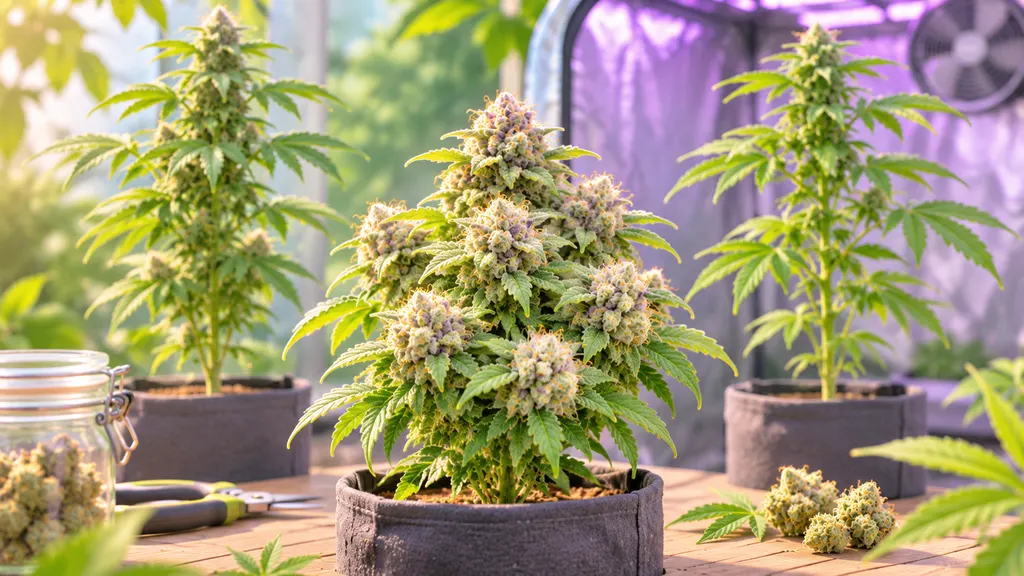
Most cannabis plants wait for the nights to get longer before they flower. Autoflowers don't: they start flowering on their own timer, which makes them quick, compact and popular with home growers. Here's where that trait comes from, how autoflowers compare with standard photoperiod plants, and what to know about growing them in Canada.
What is an autoflower strain?
An autoflower strain is a cannabis cultivar that begins flowering automatically after a set number of weeks, whatever the light schedule. Standard cannabis plants are photoperiod plants, meaning they flower in response to longer nights. Autoflowers ignore that cue.
The result is a plant that goes from seed to harvest in a matter of weeks to a few months, depending on the genetics and how it's grown. It also tends to stay short. Many autoflowers top out far smaller than a typical photoperiod plant, which suits tents, balconies and small spaces.
Autoflower is a growing trait, not a flavour or a type of high. You'll find autoflower versions of well-known families such as Gelato and Cookies, so the name of the strain and the flowering style are separate questions.
Where does the autoflower trait come from?
It comes from Cannabis ruderalis, a low-growing form of cannabis that is found in parts of Central and Eastern Europe and Asia, where summers are short and light changes quickly. Ruderalis flowers with age instead of waiting for specific day length, which helps it finish before cold weather returns.
Ruderalis on its own is small and low in THC, so it isn't much use for flower. Breeders crossed it with higher-THC cannabis to keep the age-based flowering and bring potency back. Modern autoflowers are the result of many generations of that crossing, and today's strains can carry a lot of THC even though the trait began in a low-THC plant.
Whether ruderalis is its own species or a subtype is debated by botanists. For growers, what matters is the trait itself. If you want background on how cannabis types get described, see the indica vs sativa guide.
How are autoflowers different from photoperiod plants?
The big practical difference is control. With a photoperiod plant, you decide when to flip the light schedule, so you can let it grow as large as you like first. With an autoflower, the clock starts at germination and keeps going.
That makes autoflowers forgiving of light schedules, because you don't have to manage a strict dark period to trigger flowering. It also means mistakes early on can't be fixed by simply waiting. The plant moves on whether it's ready or not.
| Photoperiod | Autoflower | |
|---|---|---|
| What triggers flowering | Longer nights (a light change) | The plant's age |
| Genetics | Mainly indica and sativa lineages | Includes ruderalis genetics |
| Time from seed to harvest | Longer, often several months | Shorter, often a few months |
| Final size | Can grow large | Usually compact |
| Yield per plant | Generally higher | Generally lower |
| Control over timing | Grower decides when to flower | Plant decides |
| Recovery from stress or pruning | More time to recover | Less time, since the clock keeps running |
| Good for | Space to spare, bigger harvests | Small spaces, fast turnaround |
Do autoflowers yield less?
Generally, yes, per plant. Autoflowers spend a short time in the growing stage, so they stay smaller and produce less flower than a large photoperiod plant given months to grow. Breeding has narrowed the gap over time, but the trade-off is still there.
The counterpoint is speed. Because they finish quickly, a grower can sometimes fit in more harvests across a season, which can offset a smaller yield per plant. Whether that works out depends on your space, your setup and how many plants you're allowed to grow.
Genetics, light, soil, watering and the strain all matter more than any single rule of thumb, so treat yield claims on seed packets as estimates, not promises.
Are autoflowers weaker than regular cannabis?
They used to be, since early autoflowers leaned heavily on low-THC ruderalis genetics. Modern autoflowers are bred much more carefully, and many produce potent flower. Potency depends on the specific strain and how it's grown, not on whether it's an autoflower.
Once the flower is harvested, dried and tested by a licensed producer, it's described on the label like any other cannabis, with THC and CBD numbers. Our guide to reading cannabis labels explains how to interpret those figures. A bud doesn't carry a note saying whether it came from an autoflower plant.
Are autoflowers good for beginners?
Many first-time growers like them. They're short, they don't need a changed light schedule and the harvest comes sooner, so the learning loop is quick. Their small size also makes them easier to hide from view and fit into limited space.
But they aren't foolproof. Their short life gives little time to recover from over-watering, nutrient mistakes or transplant shock, and roots don't like being disturbed. Many growers sow autoflowers directly in their final container for that reason. If you're comparing options, our weed seeds in Canada guide covers how seed types differ.
How do you choose an autoflower strain?
Start with the same questions you'd ask about any strain: what it smells like, how much THC it usually tests at, and how big it gets. Seed sellers list a flowering time and expected height, and those are the numbers that separate one autoflower from another.
Look for a plant that suits your space. A compact variety fits a small tent or a balcony, while a taller one needs headroom. Check whether the seeds are feminized, and whether the breeder lists the cross, since a known parent strain gives you a rough idea of aroma and growth habit.
Keep expectations realistic. Descriptions of aroma and potency on a seed pack describe the genetics at their best, and your result depends on light, soil, watering and temperature. Compare what you grow against the lab-tested products on the market using our highest THC strains guide only as a loose reference, because home-grown flower is not tested the way licensed products are.
Do autoflowers need special care?
Not special, but a gentler touch. Because the plant's clock is fixed, heavy pruning, bending and transplanting can cost it time it can't make up. Many growers use light training only, give steady water and feed lightly, and avoid disturbing the roots.
Light is the other factor. With no need for a strict dark period to trigger flowering, many growers run a long light schedule through the whole life of the plant. Others give a dark break for the roots and to cut power use. Either works for most strains, so follow the breeder's guidance for the variety you chose.
After harvest, drying and curing matter just as much as with any cannabis. Flower that is dried too fast loses aroma, and flower stored badly can go stale or grow mould, so it's worth reading how long flower lasts in does weed expire.
How many autoflower plants can you grow in Canada?
The federal Cannabis Act lets adults grow up to four cannabis plants per dwelling for personal use. Autoflowers count the same as any other plant, whatever their size, so a short plant is still one of the four.
Provinces and territories can set stricter rules, and some prohibit home cultivation altogether, so check yours first. Our growing weed in Canada guide explains where home growing is allowed and what the rules require. Seeds and plants must also come from legal sources.
Because plant sex still matters even with autoflowers, it's worth knowing how to tell male vs female weed plants. Most autoflower seeds sold today are feminized, but checking is still sensible.
Sources: laws-lois.justice.gc.ca, canada.ca, en.wikipedia.org, en.wikipedia.org