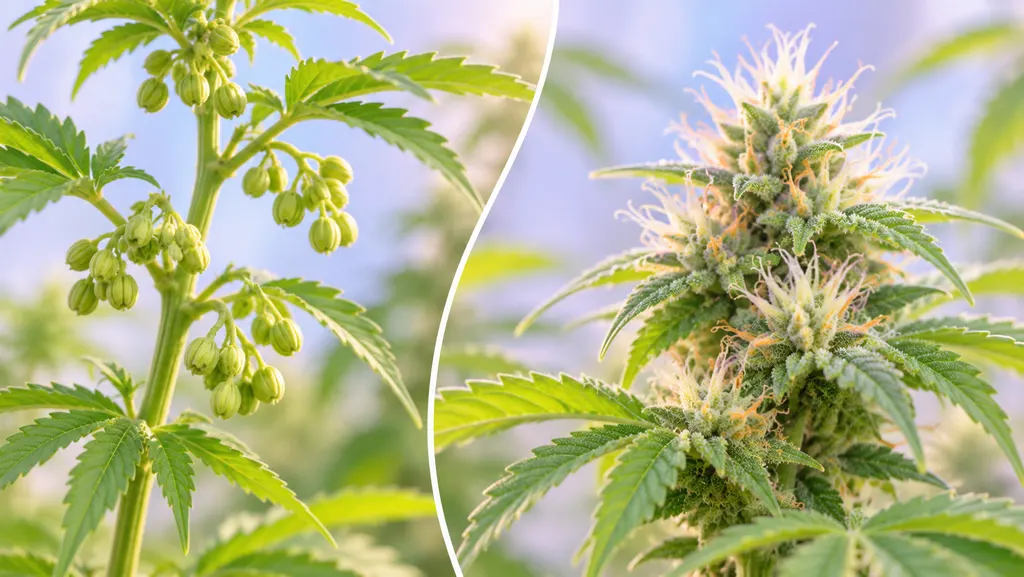
Cannabis is usually dioecious, meaning most plants are either male or female. Only females grow the flowers people consume, so telling the two apart early is one of the first jobs for any grower. Here's what to look for, when it shows, why growers want females, and how hermaphrodite plants and feminized seeds fit in.
What is the difference between male and female weed plants?
A female plant grows the buds people smoke, vape or bake with. A male plant grows pollen sacs instead, and its flowers aren't used as consumer flower. The two look alike for the first several weeks, which is why sexing a plant takes a bit of patience.
The difference comes down to reproduction. Females produce flowers that catch pollen and make seeds. Males make pollen. In nature that's how the species reproduces, but a grower who wants smokable flower rarely wants seeds.
| Sign | Male | Female |
|---|---|---|
| Pre-flowers at the nodes | Small rounded pollen sacs, like tiny balls or bananas | Pointed calyx with thin white hairs (pistils) |
| Where they appear | At the nodes, where branches meet the stem | At the same nodes |
| Flower clusters | Loose clusters of sacs that open and release pollen | Dense buds coated in resin |
| Resin (trichomes) | Little, mostly on leaves | Heavy coverage on the buds |
| Use for consumers | None | The flower that is dried and sold |
| What happens if pollinated | Releases pollen | Puts energy into seeds, not resin |
When can you tell the sex of a cannabis plant?
Usually a few weeks into vegetative growth. Plants begin to show pre-flowers at the nodes, the points where a branch meets the main stem. These are small early structures that hint at the sex long before full flowering begins.
Timing varies by genetics and growing conditions, so there's no single day to circle on the calendar. Many growers check the nodes daily with a magnifying glass or loupe once the plant is mature enough. A plant that's still in an early stage might simply not have shown its sex yet.
Sexing becomes obvious once the plant is switched to a flowering light cycle or reaches the flowering stage naturally. By then a male's pollen sacs and a female's pistils are easy to spot.
What do male pre-flowers look like?
Male pre-flowers are small sacs, rounded or slightly curved, that form at the nodes. As they develop they cluster and eventually open to release pollen. Early on they can look a little like tiny balls or short bananas, with no hairs on them.
Males also tend to grow taller and a bit lankier, with fewer leaves than females, but that's not reliable as a test on its own. The sacs are the signal that matters. Once they open, the pollen can travel on air and settle on any nearby female plants, which is why a grower removes males quickly.
What do female pre-flowers look like?
A female pre-flower has a small, teardrop-shaped calyx at the node, with one or two thin white hairs sticking out of it. Those hairs are the pistils, and they're the parts that would catch pollen. As the plant flowers, the calyxes stack up into the dense buds that make up flower.
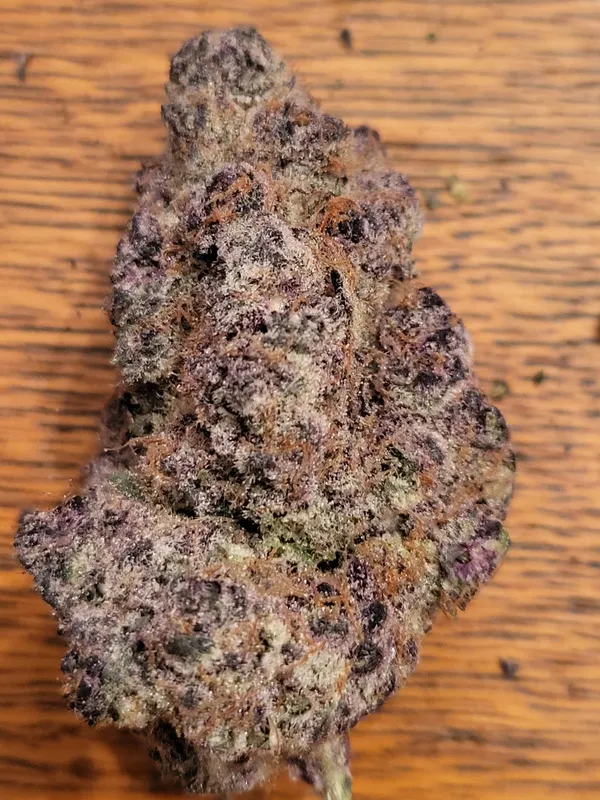
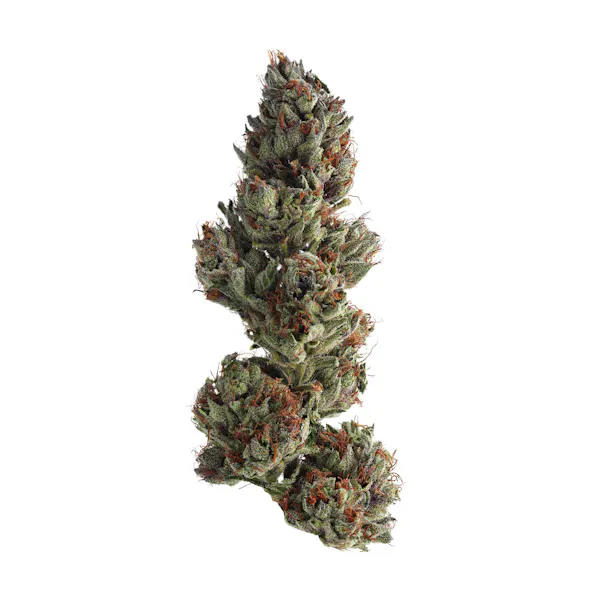
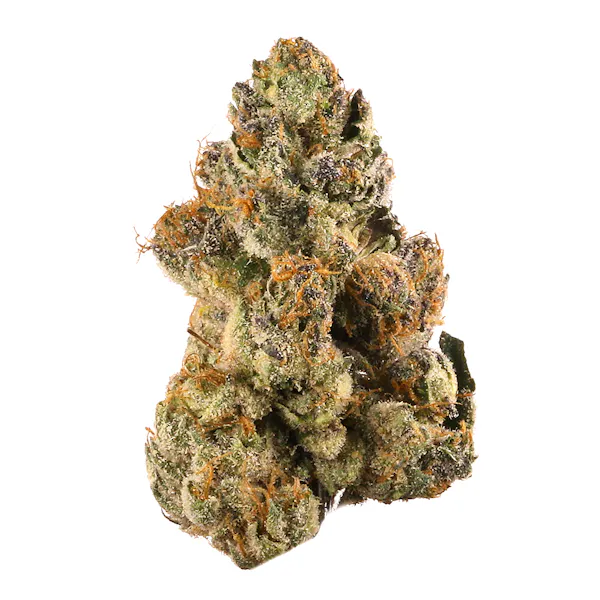
Later in flowering, the pistils start white and darken over time, and the buds become covered in resin glands. That coating is where cannabinoids and terpenes are made, which is why female plants are the focus of every cultivation setup. For more on what's on the surface of a bud, see our guide to kief and trichomes, and for the parts of the flower the cannabis leaf guide covers the plant's anatomy.
Why do growers want female plants?
Because females make the resinous, seedless flower people want. A female that is never pollinated keeps putting energy into growing resin-covered buds rather than seeds. Growers call this seedless flower sinsemilla, from the Spanish for "without seed".
If a male pollinates a female, the buds fill with seeds. Seeds make flower harsher to smoke and lower in quality, which is why commercial and home growers identify males early and remove them. A single male can pollinate a whole room, so this isn't a step to skip.
Males aren't useless to everyone. Breeders use them on purpose to make new seeds, and some growers work with the plants for fibre or breeding. But for anyone growing flower to consume, females are the goal.
What is a hermaphrodite cannabis plant?
A hermaphrodite, or "hermie", is a plant that grows both male and female flowers. Sometimes it shows female flowers with a few pollen sacs tucked in the buds. These sacs are sometimes called "nanners".
It usually happens when a plant is stressed, by things like light leaks during the dark period, heat, damage, or from certain genetics. A hermaphrodite can pollinate itself and neighbouring plants, so most growers remove it as soon as they see it.
Pollen sacs hidden in buds can also lead to seeded flower. This is one reason growers inspect plants carefully in late flowering too, not just early on.
What are feminized seeds?
Feminized seeds are produced so that nearly all the plants they grow are female. A breeder gets them by encouraging a female plant to produce pollen, then using that pollen on another female. Because the seed has only female genetics, it grows into a female plant, with far fewer males to hunt for.
They save a lot of sorting and space, which makes them popular with home growers. They are not a guarantee, though: stressed plants can still show male parts. Regular (non-feminized) seeds give a mix of males and females, and breeders often prefer them because they allow controlled crossing. For help choosing seeds, see weed seeds in Canada and the related autoflower strains guide.
How many plants can you grow at home in Canada?
The federal Cannabis Act allows adults to grow up to four cannabis plants per dwelling for personal use, not per person. Provinces and territories can add their own rules, and some limit or restrict home growing, so check where you live before you start. Our guide to growing weed in Canada goes through the rules in more detail.
The plant limit is about how many plants you have, whatever their sex. If you grow from regular seeds and some turn out male, those plants still count toward the limit until you remove them, which is another reason many home growers choose feminized seeds.
Sources: laws-lois.justice.gc.ca, canada.ca, en.wikipedia.org, en.wikipedia.org