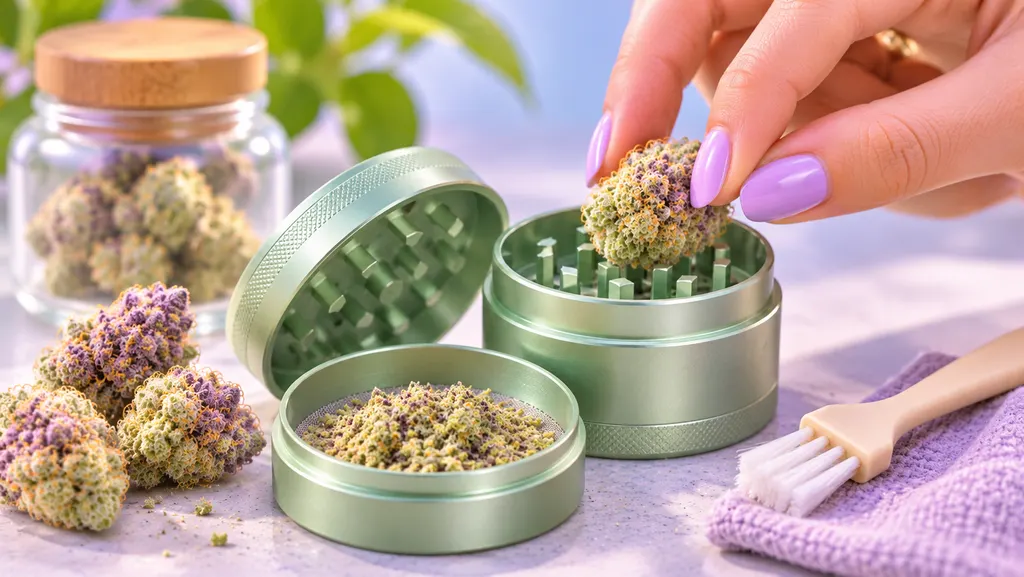
A grinder is a small handheld tool that turns whole bud into fluffy, even crumbs. That makes flower easier to pack, roll or load, and helps it burn or heat more evenly. Here's how the parts work, the steps to use one, what to do with the kief it collects, and how to keep it clean.
What does a weed grinder do?
A grinder chops dried cannabis into small, consistent pieces using rows of sharp teeth. It's quicker and neater than pulling buds apart with your fingers, and it doesn't leave resin all over your hands.
Evenly ground flower matters for how you use it. Uniform pieces pack more consistently in a bowl or pipe, roll more smoothly in a joint, and heat more evenly in a dry herb vaporizer. Pieces that are too fine can clog a screen or burn too fast, so a medium, fluffy grind is usually the target.
What are the parts of a grinder?
A 2-piece grinder is just a lid and a base, each lined with teeth. You grind inside, then open it and tip the flower out. It's compact and has the fewest surfaces for resin to stick to.
A 3-piece adds a second chamber below the teeth. Ground flower drops through small holes into that chamber, so it's tidy to store and pour from.
A 4-piece adds a fine mesh screen and a bottom chamber, called a kief catcher. As you grind, the tiny resin glands that rub off the buds fall through the screen and collect underneath as kief. See kief and trichomes for what that powder is and how people use it.
Most grinders are metal, plastic or wood. Many have a magnetic lid so it stays shut while you twist.
| Type | Parts | What it does |
|---|---|---|
| 2-piece | Lid and base, both with teeth | Grinds flower; the simplest, easiest to clean |
| 3-piece | Lid, grinding chamber, collection chamber | Grinds into a second chamber so you can pour or scoop it out |
| 4-piece | Lid, grinding chamber, screen chamber, kief catcher | Grinds, then sifts fine resin through a screen into a bottom chamber |
How do you use a grinder step by step?
It takes about thirty seconds once you've done it a few times. The steps below work for 2, 3 and 4-piece models.
- Break the bud into a few small chunks by hand, about the size of a pea or smaller. Whole large buds can jam the teeth.
- Open the grinder and place the chunks in the top chamber, the one with teeth. Don't overfill it, since packing it tight makes it harder to turn.
- Close the lid and make sure it sits flat and fully on.
- Hold the grinder firmly and twist the lid back and forth, or in one direction, for a few turns. You'll feel the flower give way as it breaks down.
- Stop once the flower is fluffy and even. Over-grinding turns it to powder, which burns fast and can fall through screens.
- Open the grinder and tip or scoop the ground flower out of the chamber you want. In a 3 or 4-piece model, it's in the chamber below the teeth.
How fine should you grind weed?
It depends on how you plan to use it. For a joint, a medium grind that still has a little structure holds together and burns evenly. For a pipe or bowl, a slightly coarser grind lets air flow through. For a dry herb vaporizer, most people go medium to fine, because more surface area heats evenly, but too fine can block airflow.
If you're not sure, start coarser. You can always grind a bit more, but you can't put it back. For a look at other devices, see how vape pens work.
What should you do with the kief?
If your grinder has a kief catcher, the powder that builds up in the bottom is concentrated trichomes. Many people keep it and sprinkle it on top of a bowl or into a joint, or save it to press into hash. Because it's concentrated, it can be noticeably stronger than the same amount of flower, so use less.
Kief collects slowly. Give it a few uses before you scrape it out. A small scraper or the edge of a card works for lifting it from the chamber. For how it relates to other resin products, see what is hash.
How do you clean a weed grinder?
Resin builds up on the teeth and in the threads over time, making the grinder sticky and hard to twist. A quick clean every few weeks keeps it working, and a deeper clean now and then keeps it from gumming up completely.
For a light clean, wipe the teeth with a cotton swab or a soft brush, tap out loose bits, and wipe the lid. An old toothbrush is good for getting between the teeth.
For a deeper clean, take it apart and soak the metal or plastic pieces in isopropyl alcohol (rubbing alcohol) in a sealed container for about 15 to 30 minutes. Shake it a little, then use a brush to loosen leftover resin. Rinse with warm water, shake off the excess and let every piece air dry completely before you use it again, so there's no alcohol left on it. Check the maker's instructions first, since some plastics and wood finishes can be damaged by alcohol, and wood grinders shouldn't be soaked.
Never use harsh cleaners that leave a residue, and keep alcohol away from flames and heat.
Does freezing a grinder help?
Yes, a bit. Resin gets brittle when it's cold, so putting a grinder in the freezer for 30 minutes to an hour makes the sticky buildup harden. You can then tap or scrape it out more easily, and some people save that flaky resin along with their kief.
You can do the same with the flower itself: slightly chilled bud tends to crumble and release trichomes more readily. Let the grinder come back to room temperature before use, so condensation doesn't leave moisture behind. For help storing flower once it's ground, check does weed expire.
Do you need a grinder to use weed?
No. You can break up buds with your fingers or scissors, and plenty of people do. A grinder just makes the job faster, cleaner and more consistent, and it saves kief you'd otherwise lose on your hands.
Whatever you use, keep tools clean, store flower in an airtight container away from light and heat, and keep everything out of reach of kids and pets. Know your local rules too: in Canada, how much cannabis you may carry is set by federal and provincial rules, and our weed measurements guide explains the limits.
Sources: canada.ca, laws-lois.justice.gc.ca, en.wikipedia.org, en.wikipedia.org