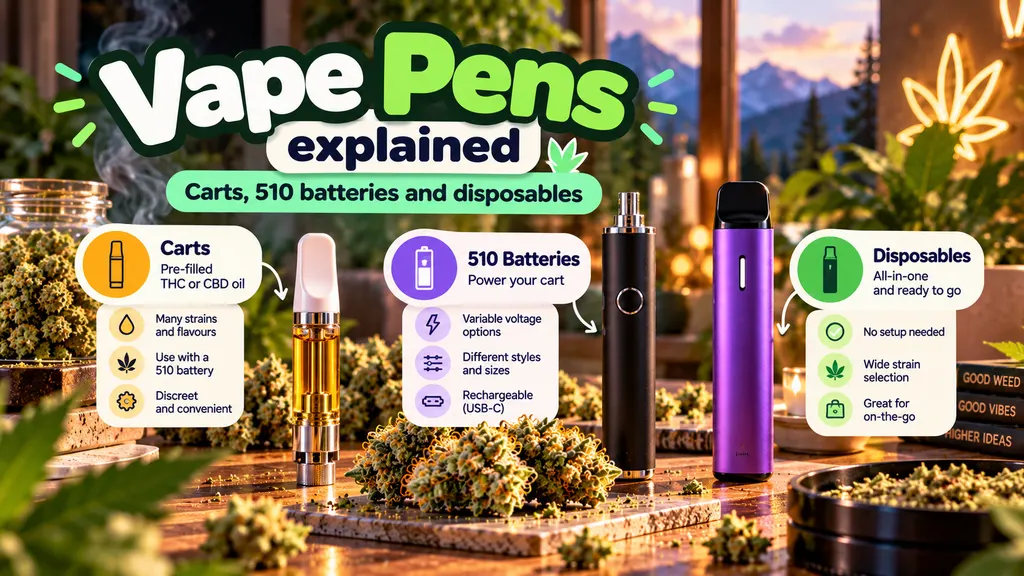
Search for a weed pen and you'll find four quite different things sold under one name. Some are a cartridge you screw onto a battery, some are a single sealed unit you throw away, some use a proprietary pod, and some heat dried flower instead of oil. This guide sorts them out in plain terms, explains what "510" means, covers how Canadian rules and labels apply to vape products, and gives the basics on battery safety.
What is a weed pen, and how does it work?
A weed pen, also called a vape pen or pen vape, has two basic parts: a battery and something that holds the cannabis. The battery sends power to a small heating element (a coil or ceramic piece). The heat turns the extract into vapour, and you breathe that vapour in. Nothing is set on fire, which is the main difference from smoking a joint, blunt or spliff.
Most pens use cannabis extract, a concentrated oil made from the plant, rather than flower. How that oil is made affects what ends up in the cartridge, and our guide to rosin, live resin and distillate explains the common types. Oil is also where the THC number comes from. The raw plant makes THCA, which converts to THC with heat, a process covered in our THCA vs THC guide.
Pens differ in how the pieces are packaged. That packaging decides whether you can swap a cartridge, whether you can recharge the battery, and whether a product from one maker works with another maker's hardware.
What are the main types of vape pens?
510 cartridge and battery. The cartridge screws onto a battery through a standard thread called 510. Because the thread is a shared standard, you can use one battery with cartridges from different makers. This is the most flexible setup, and it is what most people mean by "carts".
All-in-one disposable. The battery, heating element and oil are built into a single sealed unit. There is nothing to attach and nothing to refill. When the oil or the charge runs out, the whole unit is done. Some disposables can be recharged to finish the oil, others cannot.
Pod system. A pod is a cartridge designed for one specific battery body. It often snaps in with magnets or a click fit rather than a thread. The trade-off against 510 is that pods are tied to the maker's hardware, so a pod from one line will not necessarily fit another line's battery.
Dry-herb vaporizer. This is a different kind of device. It heats ground flower in a small chamber to a set temperature, below the point where it would burn. It does not use a cartridge of extract at all.
| 510 cartridge + battery | All-in-one disposable | Pod system | Dry-herb vaporizer | |
|---|---|---|---|---|
| What's inside | A cartridge of extract with a heating element, plus a separate battery | Battery, heating element and extract in one sealed body | A pod of extract that clicks into a matching battery body | A heating chamber for ground flower and a battery |
| Refillable? | Cartridge is normally sold pre-filled; the battery is reused | No, it's sealed | Pods are normally sold pre-filled | Yes, you load your own flower |
| Rechargeable? | Battery is, usually by USB | Some are, some are not; check the package | Battery body is | Yes |
| Compatibility | Any 510 thread cartridge fits any 510 thread battery | Nothing to match; use it as sold | Usually only the maker's own pods fit | Takes dried flower, not extract cartridges |
What does 510 thread mean on a vape battery?
The 510 thread is simply the screw fitting at the base of a cartridge and the top of a battery. If both are 510, they screw together. It is a connector standard, much like a standard USB port, and it says nothing about quality or about how strong the oil inside is.
A 510 battery usually works in one of two ways. A draw-activated battery turns on when you inhale, with no buttons. A button battery heats while you press a button, and some let you choose between a few power settings. Both are rechargeable, normally by USB.
A few points help when you are matching parts:
- A 510 cartridge needs a 510 battery. A pod or a proprietary cartridge will not screw on.
- Some batteries are sold paired to one maker's cartridges even when they look standard, so read the package.
- A battery sold without a charger needs one made for it. See the safety section below.
- If a cartridge does not heat, a loose thread connection is a common cause; unscrewing it slightly and refitting it sometimes fixes the contact.
Are cartridges, disposables and pods all legal in Canada?
Yes, when they are bought through the legal market. Cannabis extracts, which include the oils used in vape cartridges, became legal products when the Cannabis Regulations amendments took effect on October 17, 2019. Health Canada's backgrounder at the time said sales were expected to start no earlier than mid-December 2019, with a limited selection at first.
Each province and territory runs its own retail system and can add its own rules on top of the federal ones, so what a store carries and how it is sold varies by region. For local rules, the provincial regulator or the provincial retailer is the place to check. We don't summarize every provincial rule here because they change.
How much THC can a vape cartridge legally hold?
Health Canada's consumer guidance lists extracts for inhalation, including those in vape pens, as having a maximum of 1,000 mg of THC per container. The 2019 backgrounder gives the same cap for each package of extract. Separately, the 10 mg per unit limit applies to discrete units such as capsules, not to a cartridge.
Federal rules also limit what goes into extracts. Per Health Canada's backgrounder, ingredients that could appeal to young people, such as sweeteners and colourants, are prohibited in extracts, and certain flavours cannot appear on labels. Pre-filled vape accessories must carry the standardized cannabis symbol and meet the packaging requirements.
How do you read the THC number on a vape?
A legal Canadian label states Total THC, which counts THC plus the THC that THCA can become. On extracts it is usually shown as a concentration in milligrams per gram (mg/g) and as the total milligrams in the container, so a cartridge can be compared with another on equal terms. A higher number is a higher concentration; it is not a promise about any particular experience.
Our guide to reading cannabis labels walks through the rest of the package, including the symbol, the stamp and the lot details. Labels also tell you the extract type and sometimes list terpenes such as limonene or myrcene. If a cartridge lists terpenes, they usually come from cannabis itself. Type words like indica and sativa are weak guides to what a product is like, as our indica vs sativa guide explains.
Note that the label tells you what the lab measured, not how many puffs the cartridge holds. Draw length, battery power and how often you use it all change how long a cartridge lasts.
What is a blinker?
"Blinker" is slang for one long pull on a vape that continues until the device's indicator light blinks and the power cuts off, according to one cannabis retail site's explainer. It describes a way of using a vape, not a type of device. It is also, separately, a product name used by one Canadian licensed producer for a battery and pod line, so the word can mean two different things depending on where you see it.
We mention it because people search for it, not because we recommend it. Taking a long pull simply means you take in a larger amount in a single go, which is worth knowing when you compare the THC figure on a cartridge with how it is used. Whatever your approach, start with small amounts and give a product time before you take more.
What was the vaping lung injury outbreak, and why does it matter for buying?
In 2019 the United States saw an outbreak of lung injury associated with e-cigarette or vaping product use, known as EVALI. Health Canada's page on vaping-associated lung illness says evidence from that outbreak suggests a possible link to vitamin E acetate, a compound that was used as a diluent in unregulated vaping products. It also says vitamin E acetate had not been found in any Canadian cases as of the page's 2022 update, and that no specific cause was identified for the Canadian cases.
The practical point Health Canada makes is about sourcing: it advises against using vaping products from illegal or unregulated sources. Illegal products are not tested or quality controlled, and their THC information may be inaccurate. Legal products from authorized retailers are lab tested and must meet the labelling and ingredient rules above. Health Canada also asks people to report adverse reactions involving cannabis vapes.
That is the reason to buy from a licensed store only. A cartridge with no excise stamp, no standardized symbol or no lot information has not been through that system.
How do you use a vape battery safely?
Vape batteries are lithium-ion batteries, the same kind used in phones and many other devices. Health Canada's battery safety factsheet lists vaping products among the devices that use them and says these batteries can overheat if mishandled. Its general advice is worth following for a vape battery:
- Use a charger with a Canadian certification mark, and if you replace one, match its voltage (V) and current (A) to the device.
- Use the charger and cable made for your device. Fire services in Canada give the same advice for vape batteries specifically.
- Charge on a hard, non-flammable surface, away from bedding and couches.
- Stop using a battery that swells or overheats, and never modify or tamper with it.
- Ask your municipality how to dispose of batteries and spent devices, rather than putting them in household garbage.
Dry-herb vaporizer or cartridge pen: which should you pick?
The choice mostly comes down to what you want to put in it. A cartridge pen is compact and needs almost no preparation, because the oil is already measured out in a sealed cartridge. A dry-herb vaporizer takes ground flower, so you can choose from any strain you like, such as an indica, sativa or hybrid, but you need to grind and load it, and clean the chamber now and then.
Cost works out differently too. A cartridge pen is cheap to start with but each cartridge is a recurring purchase. A dry-herb device costs more up front and then runs on flower you buy anyway. Neither is the right answer for everybody, and the legal limits and labels described above apply to the product you buy, whichever device you use.
Sources: canada.ca, canada.ca, canada.ca, canada.ca, laws-lois.justice.gc.ca, weedmaps.com