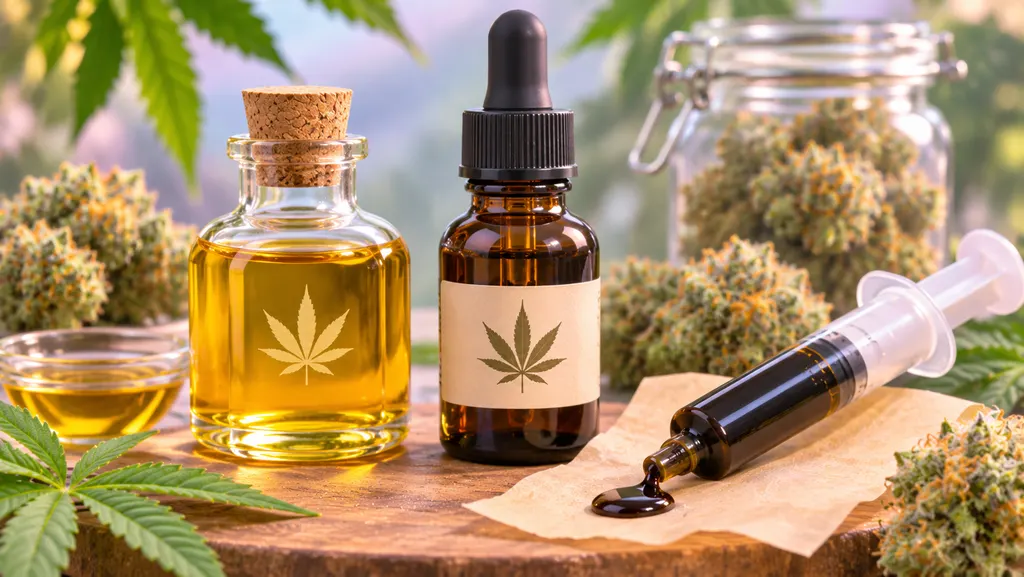
Tincture, oil, THC oil, RSO and FECO all describe the same basic idea: cannabinoids pulled out of plant material and into something you can measure. The names come from marketing history, not chemistry, and the Canadian rules that govern these products are not the ones most pages quote. Here is what each term usually means, what the law caps, and why the number on a bottle is harder to trust than it looks.
What is the difference between a tincture, cannabis oil and RSO?
In the strict sense, a tincture is an alcohol extraction and an oil is a fat-based one. In the way the market actually uses the words, there is no reliable difference, and the only way to know what you have is the label and its test results.
Ask three questions of any bottle: how much cannabinoid is in each millilitre, what is the carrier, and was it tested. Those answers tell you what the product name does not. Our guide to reading cannabis labels covers where to find the first one.
For the inhaled side of extracts, see our rosin, live resin and distillate guide and what a dab is.
| Tincture | Cannabis oil | RSO | |
|---|---|---|---|
| Usually means | Extract in a liquid carrier, dosed by dropper | No fixed meaning: anything from a dilute solution to a concentrate | Dark, thick, unrefined whole-plant extract |
| Strict definition | An alcohol extraction | None | Named after the person who popularised the recipe |
| Typical carrier | Ethanol, or more often an oil such as MCT | An oil, or none | None: it is the extract itself |
| How it is dosed | Graduated dropper | Dropper, syringe or capsule | Small amounts from a syringe |
| Legal class in Canada | Cannabis extract (ingested) | Not a class: edible, extract or topical | Cannabis extract |
Is "cannabis oil" a legal product class in Canada?
No. The definition of cannabis oil was repealed in 2019, and the term has no legal meaning in Canada. The Cannabis Regulations print it as "cannabis oil [Repealed, SOR/2019-206, s. 1]".
Classification now follows how a product is used rather than what it is made of. Health Canada's guide says a cannabis product containing cannabis oil "could be an edible cannabis, a cannabis extract or cannabis topical", and that producers are expected to choose the class based on factors including formulation, intended use, mode of consumption and how the product is represented.
So the class follows the claim on the bottle, not the liquid inside it. Each class carries different limits, which is why two bottles with similar contents can show very different THC figures and both be legal.
Is a tincture an edible or an extract under Canadian law?
A tincture is a cannabis extract, and because the Regulations say "ingestion includes absorption in the mouth", it counts as an ingested extract. That puts it under the extract limits in the table, not the edibles ones.
The practical point is the gap between 10 mg and 1,000 mg. A legal edible package tops out at 10 mg of THC, while a legal extract container may hold up to 1,000 mg. The per-unit and per-activation caps keep a single measured dose small, but a plain dropper bottle has no such metering, so the arithmetic is on you.
| Rule | What it says | What it means for a bottle |
|---|---|---|
| THC per container | An extract must not contain more than 1,000 mg of THC per immediate container | Far above the 10 mg edibles package figure |
| THC per discrete unit | Each discrete unit intended for ingestion must not exceed 10 mg of THC | Capsules and other portioned units stay small |
| THC per activation | A dispensing mechanism must not release more than 10 mg of THC per activation | A metered pump is capped per press, not per bottle |
| Label accuracy | THC and CBD must be within 85% to 115% of the figure displayed | A legal tolerance, not a guarantee |
| Ingredients | Only carrier substances, flavouring agents and substances that keep the product stable | Sugars and sweeteners are not allowed |
Does holding a tincture under your tongue work faster than swallowing it?
Nobody has shown that it does. The one controlled comparison found no difference between an oromucosal cannabis spray and swallowed THC. The mechanism sounds sensible, but for cannabis the advantage is unmeasured rather than proven or disproved.
That study gave nine cannabis smokers swallowed THC and a metered oromucosal spray across five sessions. The authors report no statistically significant differences in peak concentration, time to peak or total exposure. It is a small study, with a pharmaceutical spray rather than a dropper, and it measured blood levels rather than how quickly anyone noticed an effect.
A systematic review of cannabidiol studies reached a similar place. Out of 792 articles screened, only the smoking route had an absolute bioavailability figure, 31%, and the reviewers wrote that no other studies attempted to report it for other routes in humans.
How long does a tincture take to work?
Plan around the slower, swallowed clock. A tincture dose is partly absorbed in the mouth and partly swallowed, in a ratio nobody measures, so the safest assumption is that it behaves somewhere between the two.
That is why the same bottle can feel different from one day to the next. How long you hold it, how much you salivate, the carrier and what else is in your stomach could all shift the split, and none of those has been measured for cannabis preparations. Our guide on how long edibles take gives the timings for the swallowed route, which are the conservative ones to work from.
No source we found gives a reliable hold time in seconds for a cannabis tincture, so this guide does not give one either.
- Read the per-millilitre figure first: a bottle is a concentration, not a dose.
- Measure with the graduations on the dropper, not a squeeze.
- Start well below the amount you think you want, especially with a new product.
- Wait longer than feels necessary before taking more.
- Write down what you took and when.
What is RSO, and is it the same as FECO?
RSO is a dark, thick whole-plant extract, usually sold in a syringe, named after the person who popularised the home recipe. The syringe is simply the practical way to portion something too viscous to pour. It is not a medical device.
FECO stands for full-extract cannabis oil and describes much the same unrefined concentrate. The usual distinction is the solvent: FECO is typically linked to ethanol, RSO to the original recipe's petroleum-based solvents. Treat both as marketing lineage. Neither name tells you the cannabinoid content, the solvent actually used or whether anything was tested.
RSO is surrounded by large claims online. This site makes none of them. Health Canada's information for health care professionals says that cannabis is not an approved product for medical use unless a specific product has been issued a drug identification number and a notice of compliance, and we have not found a published clinical trial that names RSO itself. That is a statement about the evidence, not a verdict either way.
Which solvents are used to make cannabis oil?
Ethanol, isopropyl alcohol, petroleum-based solvents, butane and carbon dioxide are all used, and the choice is not cosmetic. A review of the oil category describes the range as running from relatively innocuous solvents such as ethanol and isopropyl alcohol to more harmful ones such as petroleum ether and naphtha, or supercritical fluids such as butane and CO2.
The same review points to the residual presence of toxic solvents from extraction as a contaminant specifically relevant to cannabis oils. That is the reason residual-solvent testing exists, and why a test result matters more for a thick extract than a product name does.
An ethanol tincture keeps its solvent by design, so it is not a solventless product. Do not confuse it with solventless extracts such as rosin.
Why is the strength of a liquid extract so hard to pin down?
Because extraction is sensitive, and even professionals following a written method do not reliably hit a target. In that study the relative standard deviation for THC and CBD was above 50% across the board. The authors linked much of the variation to an optional preheating step that differed between operators.
Untested bottles fare worse. One analysis of 46 oils collected from users, 29 home-made and 17 bought, found that label information existed for only 21, and that in many cases the measured content differed strongly from the claim. In 7 samples no cannabinoids were found at all, and one sample peaked at 57.5% THC.
| Preparation (5 g in 50 ml) | Relative standard deviation | Samples |
|---|---|---|
| THC-dominant | THC 82% | 123 |
| Balanced | THC 53%, CBD 91% | 54 |
| CBD-dominant | THC 58%, CBD 59% | 11 |
Can you make a tincture or oil at home?
You can make a fat or alcohol infusion, but you cannot know its strength. The folk method is decarboxylated plant material, high-proof spirit, time and a strainer. The chemistry works, which is exactly why it is used commercially, but the pharmacy data above shows how much strength moves even with standardised input and a written protocol.
Two cautions apply to this format in particular. A concentrated liquid is far easier to over-pour than a gummy is to over-eat, and an unlabelled dropper bottle looks like every other dropper bottle in the cupboard. Also, high-proof alcohol near heat is a fire hazard before it is a cannabis question.
If you infuse fat for food, our guides on how to decarb weed and how to make cannabutter explain the method and why a homemade dose cannot be calculated.
Does the carrier oil matter, and how should you store a tincture?
The carrier changes taste, texture and shelf life. No controlled comparison we found shows it changes how much reaches you. MCT oil is common because it is neutral, stays liquid and keeps well.
Store liquid extracts cool, dark, upright, tightly capped and labelled with the contents and the date. Amber glass is functional, not decorative. The carrier can degrade as well as the cannabinoids, so a bottle that smells rancid is no longer the product you bought. Keep every bottle and syringe out of reach of children and pets: a concentrated liquid is easy to over-take by accident.
Should you choose a tincture, an edible or a concentrate?
It depends on whether you want a readable dose, fine adjustment or a quick onset, and no format gives you all three. A tincture's real advantage is that you can adjust a dose in small steps, but its onset is less predictable because of the split route.
If you want a figure you can check, choose any tested, labelled product and read its certificate of analysis. If you prefer CBD-dominant products, see our high-CBD strains guide for flower, and remember that strain names do not predict the chemistry of an extract.
Sources: laws-lois.justice.gc.ca, canada.ca, canada.ca, doi.org, doi.org, doi.org, doi.org, doi.org