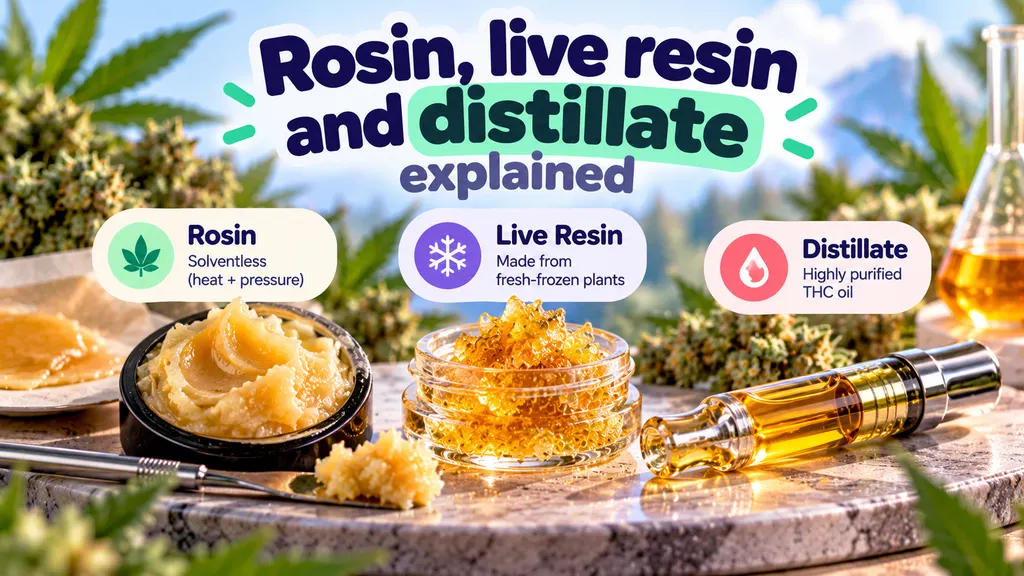
Walk into a Canadian store and the concentrate shelf can read like a foreign language: rosin, live rosin, live resin, shatter, badder, distillate, hash, kief. Most of those words describe two things, how the product was made (with a solvent or without) and what it was made from (dried or fresh-frozen plant). Once you have those two ideas, the rest is texture and labels.
What is a cannabis concentrate?
A concentrate (Health Canada's regulations call the broad group cannabis extracts) is cannabis with most of the leaf and fibre taken out, leaving the trichomes, the tiny resin glands on the flower that hold the cannabinoids and terpenes. Less plant material in the product means more cannabinoid per gram.
How much more? The Ontario Cannabis Store compares dried flower at roughly 10% to 25% THC with concentrates that can pass 50%, and some that reach 90% or higher. Those are broad ranges and individual products vary, so the number to trust is the one on the package.
The Cannabis Regulations define a cannabis extract as a substance produced by extraction processing of cannabis material, or a synthesized substance identical to a plant cannabinoid. Edibles and topicals are separate categories. The regulations also define a cannabis concentrate as a substance with more than 3% THC by weight, counting the THC that the THCA in it can become.
| Type | Solvent? | Made from | Texture |
|---|---|---|---|
| Kief | No | Loose trichomes sifted from flower | Green powder |
| Hash, bubble hash | No | Trichomes collected from flower, then pressed for hash | Pressed ball or brick; bubble hash is a sticky, dabbable solid |
| Rosin | No | Dried flower, hash or kief | Translucent, sap-like |
| Live rosin | No | Fresh-frozen plant, often made into hash first | Soft, sap-like; varies by press |
| Live resin | Yes | Fresh-frozen plant | Golden, saucy to syrupy |
| Shatter | Yes (butane) | Cannabis processed with butane, solvent then evaporated | Translucent hard sheet |
| Wax, badder, budder | Yes | Shatter-type extract whipped with air | Creamy |
| Distillate | Yes, in the refining chain | Refined extract | Thick, clear to golden oil |
| THC crystals, isolate | Yes | Purified single cannabinoid | Crystalline solid |
What is rosin?
Rosin is a solventless concentrate. Cannabis is pressed between heated plates for a few minutes, and the resin squeezes out. No chemical solvent is used at any point, which is why people looking for a "clean" concentrate often start here. The Ontario Cannabis Store describes the result as translucent and sap-like, and notes that rosin can be pressed from dried flower, from hash or from kief.
The starting material changes the price and the product more than the press does. Flower rosin is pressed straight from bud. Hash rosin is pressed from hash that was already collected from the plant, and it generally gives a more refined result, though the strain and the grower matter as much as the method.
Because terpenes are volatile, producers keep the temperature of the plates down. That is the reason a good rosin tends to smell like the flower it came from.
What is live rosin?
Live rosin is rosin made from fresh-frozen plant instead of dried, cured flower. The plant is frozen soon after harvest and never goes through drying, so the resin is collected while the plant is still fresh. Industry sources describe the usual route as turning the frozen material into ice-water hash first and then pressing that hash.
The thinking behind it is that drying and curing lose some of the aromatic compounds, terpenes such as myrcene and limonene, and skipping those steps keeps more of them. That is an industry claim about aroma, not something this guide can measure for you. What you can check is the label and the lab results, and your own nose.
Live rosin is usually soft and can change over time if it is stored warm. Keeping it cool is the common advice from producers.
What is live resin?
Live resin also starts from fresh-frozen plants, but it is made with a solvent. The Ontario Cannabis Store describes it as a golden extract with a consistency from saucy to syrupy, made from fresh rather than dried cannabis. Hydrocarbon solvents such as butane are the usual choice in the industry, and the solvent is then removed.
So the difference between live rosin and live resin is not the plant. It is the method. Live rosin is squeezed with heat and pressure. Live resin is dissolved out with a solvent and purged. Both can taste and smell strongly of the strain, and both are sold as concentrates in Canada.
If the package does not say how the product was made, the product page or the producer's own information is the place to look. Do not assume a package states the production method.
What is distillate?
Distillate is a refined cannabis oil. A crude extract is purified until it is mostly cannabinoids, which gives a thick, clear to golden oil with a high THC number and, by itself, very little flavour. The Ontario Cannabis Store lists distillate among its solvent-made concentrates and describes it as an extremely concentrated oil that can contain a range of cannabinoids.
Because refining removes much of the aroma, distillate is the usual base for vape cartridges and for infusing other products, and some producers add terpenes back afterwards. Our vape pens guide covers how those cartridges differ.
Heat is part of the refining chain. Heating turns THCA into THC, which is the same chemistry described in THCA vs THC, so a distillate's THC figure is usually mostly plain THC rather than THCA.
What are shatter, badder and budder?
Shatter is made by processing cannabis with butane and then evaporating the leftover solvent over low heat. It cools into a translucent, glassy sheet, and the Ontario Cannabis Store classes it as a butane hash oil. The name comes from the way it breaks.
Wax is shatter-type extract that has been whipped so air gets in, which gives a creamy, opaque texture. Badder and budder are common names for that same soft, whipped texture. The label on the package, and the product description, are better guides than the name, because stores and producers use these words loosely.
Texture is mostly about handling. A product that is hard and glassy and one that is soft and creamy can contain the same cannabinoids. What differs is how easy it is to portion and how it responds to warmth.
What are bubble hash and kief?
Both are solventless and both are older than anything else on this page. Kief is the loose powder of trichomes that falls off flower, a green powder that the Ontario Cannabis Store describes as essentially hash before it is pressed. Pressed together, those trichomes become hash, a dense ball or brick.
Bubble hash is a hash made by agitating plant material in ice water and collecting the resin heads that separate, rather than by dry sifting. The result is a sticky, highly concentrated solid. It is also the usual starting point for hash rosin.
Kief is the easiest of these to meet in everyday life, because it collects at the bottom of a grinder, and it is often sprinkled onto flower or sold in infused pre-rolls.
What are THC crystals and diamonds?
THC crystals are a purified, single-cannabinoid form of THC. The Ontario Cannabis Store describes isolate as containing only THC or only CBD, and lists diamonds among the concentrates, with one listed diamond product at 84% to 92% THC. Crystals are usually mixed into other products or sold as a base for dabbing.
Isolate is as far from the plant as a cannabis product gets. There are no terpenes in it unless the producer adds them back, so two products with the same THC figure can still behave and taste very differently.
Are cannabis extracts legal in Canada?
Yes. Extracts, edibles and topicals became legal to sell in Canada in October 2019, a year after flower and oils. They are sold through the same licensed channels: provincial retailers, licensed private stores and the online shops that provinces allow.
The Cannabis Regulations set a cap of 1,000 mg of THC per immediate container for cannabis extracts, counting the THC that THCA could become (section 101.2). A discrete unit meant to be swallowed or used nasally, rectally or vaginally can contain no more than 10 mg of THC (section 96). A few extracts, such as those with at least 10 mg of THC in a liquid form, also need a dispensing mechanism that releases no more than 10 mg per activation (section 122.5).
Two other rules matter for what is in the container. The THC or CBD in an extract has to land between 85% and 115% of the labelled amount (section 97), and an extract must not contain anything that may injure health when used as intended, a rule that exempts the injury from combustion and inhalation itself (section 101).
How do I read a concentrate label in Canada?
Canadian concentrate labels show THC and CBD content in milligrams per gram, according to the Ontario Cannabis Store, and the regulations count the THC that THCA can become when measuring it, as described in THCA vs THC. That makes it a fair way to compare products, whether the product is a rosin or a distillate. Our guide to reading cannabis labels walks through the rest of the panel.
A 1 g container at 800 mg/g holds 800 mg of THC, which is under the 1,000 mg cap. A 2 g container at the same strength would hold 1,600 mg and so could not be sold, so the cap limits how strong a large container can be.
Strain names still show up on rosin and live resin, because those products keep more of the plant's character. Learn what indica, sativa and hybrid labels do and do not tell you in indica vs sativa before you let them steer a purchase.
Because a gram of concentrate holds far more THC than a gram of flower, the sensible habit is to start with a very small amount and compare by the milligrams on the label, not by the name on the shelf.
Sources: laws-lois.justice.gc.ca, laws-lois.justice.gc.ca, laws-lois.justice.gc.ca, ocs.ca, ocs.ca