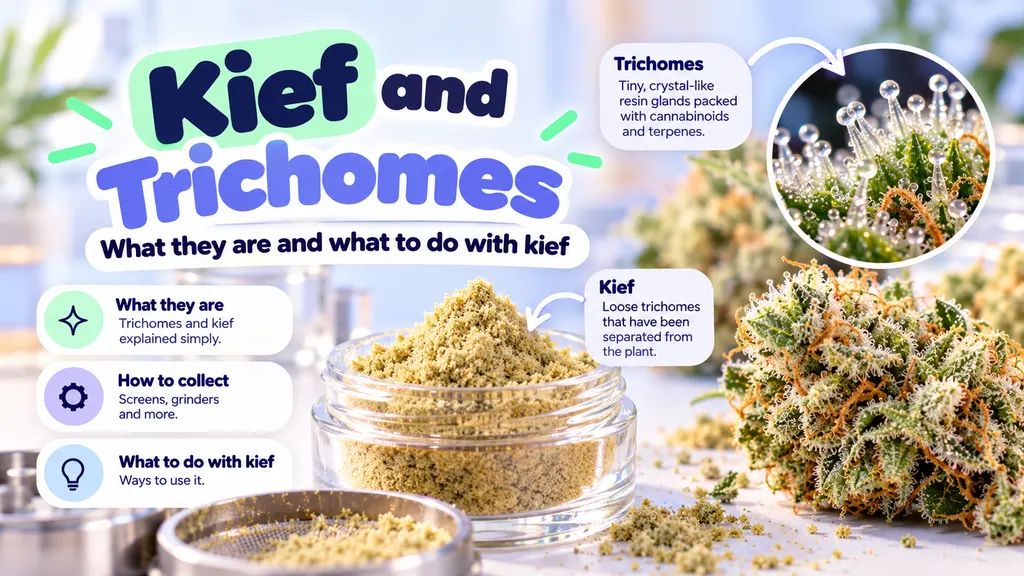
Open a three-piece grinder after a few sessions and there is a fine, greenish-gold powder under the screen. That is kief, and it is made of trichomes, the glands that make the plant's cannabinoids and terpenes. Here is what trichomes are, the main types botanists describe, how kief compares with hash and rosin, what people do with the kief from their grinder, and how it is handled under Canadian rules.
What are trichomes on cannabis?
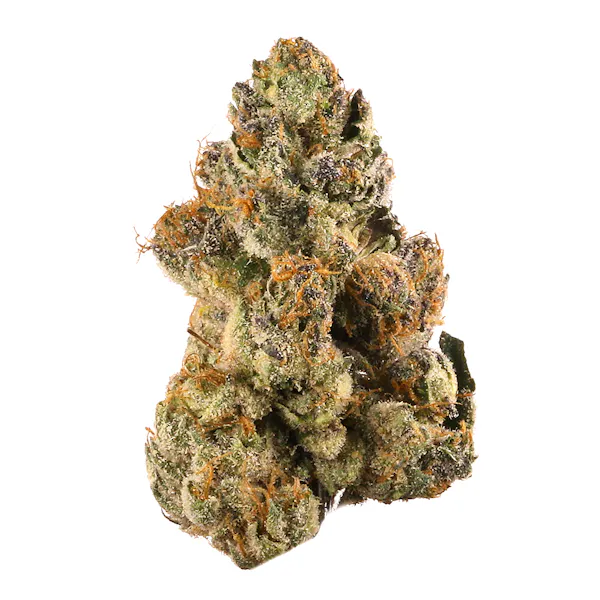
Trichomes are small hair-like growths on the surface of the plant. On cannabis, the glandular ones are the resin factories: they are where cannabinoids such as THCA and terpenes are made and stored. Under magnification they look like tiny mushrooms or glass beads scattered across the flower, which is what gives a good bud its frosted look.
They are concentrated on the flower. A 2023 study of high-THC cannabis found the glandular heads on the bracts, the leaf-like parts that surround the flower, and also reported them on leaves. This is why the small sugar leaves tucked into the bud are frosty while the large fan leaves are not. Our guide to the cannabis leaf covers that difference.
The picture above labels where they sit on a bud, alongside the pistils and calyxes.
Anatomy of a cannabis bud
- Cola: The top of the flower, where buds stack into one tall cluster. A plant's main cola is usually its largest bud.
- Pistils: The hair-like strands, white at first and orange or red as the plant matures. Their colour says little about strength.
- Trichomes: The frosty crystals covering the bud: tiny glands that make most of the plant's cannabinoids, like THC and CBD, and its terpenes.
- Sugar leaf: Small leaves tucked into the bud and dusted with trichomes. Growers trim them close, and the trim is often used for extracts.
- Calyx: The teardrop-shaped pods that make up the bud. They're where trichomes are densest.
- Resin: The sticky oil held in trichome heads. It's what makes buds tacky, and what concentrates like hash and rosin collect.
- Stem: The woody stalk that holds the flowers. It's mostly trimmed away before sale and carries little THC.
What types of trichomes does cannabis have?
Botanists sort cannabis glandular trichomes into three kinds by shape and size: capitate-stalked, capitate-sessile and bulbous. Capitate means the gland has a rounded head, and the names describe what holds the head up.
The capitate-stalked trichome is the one people picture when they say trichome. It has a wide head on a visible stalk, and it is the main place where cannabinoids and terpenes collect. In the 2023 study, heads measured 40 to 110 micrometres across, and stalk lengths ranged from 20 to 1,100 micrometres. A micrometre is a thousandth of a millimetre, so these are barely visible to the naked eye, which is why a magnifier is the grower's tool.
Sessile trichomes sit close to the surface, with at most a very short stalk, and bulbous ones are the smallest. Sizes and roles for these two vary between papers, and some sources disagree on how much the bulbous type produces, so treat their details as less settled. What is clear is that the stalked type dominates the resin you can collect from the bud.
As flower ripens, trichome heads change colour. The same study describes them going from clear to cloudy to amber or brown. Growers use that shift as a rough guide to harvest timing, but the colour alone doesn't tell you a product's strength. Only a lab result does.
| Type | Size reported | What the study found |
|---|---|---|
| Capitate-stalked | Heads 40 to 110 µm across; stalks 20 to 1,100 µm long | The main site of cannabinoid and terpene build-up; found mainly on bracts |
| Capitate-sessile | No separate size given | Sit directly on the surface without a stalk; found on bracts and leaves; the study treats them as an earlier stage of the stalked type |
| Bulbous | Heads 15 to 30 µm across, on stalks 10 to 15 µm tall | Smallest; found on bracts and leaves; secrete small droplets of resin |
What is kief?
Kief is the loose powder made of trichomes that have broken off the flower. The Ontario Cannabis Store describes it as a green powder made up of the flower's trichomes, essentially hash before it is pressed, and notes that it is also called sift.
It forms by friction. Grinding, handling and moving the flower snaps the brittle heads off their stalks, and the grinder's mesh lets them fall through to a separate chamber. Nothing is added and nothing is removed, so kief is still plant material, just the resin-rich part of it with most of the leaf and fibre left behind.
Because it is mostly trichome and little else, kief is more concentrated than the flower it came from. The exact potency depends on what it was collected from and how much plant material is mixed in, so check any labelled product rather than guessing.
What can you do with the kief in your grinder?
Most of those uses are the same ways you would use the flower, just in a smaller, stronger amount. Whatever you choose, start with much less than you think you need. Health Canada's guidance on lowering risks tells new or occasional users to avoid hash, kief, wax and shatter, because their high THC concentration can cause greater impairment. The same page advises starting low, going slow and waiting before taking more.
To store kief, keep it in an airtight container in a cool, dark place, away from heat and light. Cannabinoids break down slowly over time, so cool and dark is the safe default. Our guide on whether weed expires covers storage in more detail.
- Sprinkle it on top of flower in a bowl or a joint. It is the simplest use, and a little goes a long way.
- Mix a pinch into ground flower before rolling or packing.
- Press it into hash. Kief pressed together forms a small block, which is how the Ontario Cannabis Store describes hash.
- Cook with it, but heat it first. Like flower, kief is mostly THCA until it is heated, so it needs decarboxylating before it is added to butter or oil.
- Save it. A grinder collects kief slowly, and many people let it build up before using it.
What is the difference between kief, hash and rosin?
They are three steps along the same road. Kief is the loose powder. Hash is that powder pressed together, which the Ontario Cannabis Store describes as trichomes pressed into a ball or brick. Rosin goes one step further: heat and pressure squeeze the resin out as a translucent, sap-like concentrate, with no solvent involved.
A related product is bubble hash, where the trichomes are separated using ice water rather than dry sifting. Rosin is often pressed from hash made that way. For the full breakdown, including the solvent-made concentrates, see our guide to rosin, live resin and distillate.
| Kief | Hash | Rosin | |
|---|---|---|---|
| What it is | Loose trichome powder | Trichomes pressed into a ball or brick | Resin squeezed out with heat and pressure |
| Solvent used? | No | No | No |
| Made from | Flower, collected by sifting or grinding | Kief or trichomes collected from the plant | Dried flower, hash or kief |
| Texture | Green powder | Solid ball or brick | Translucent, sap-like |
Is kief legal in Canada and what does the label say?
Yes, as part of the legal market. The Ontario Cannabis Store's extracts page describes both kief and hash as concentrates sold in its range. Whatever you buy has to carry the standard Canadian label, including Total THC and the red standardized cannabis symbol, which is required for products with more than 10 micrograms of THC per gram. Our guide to reading cannabis labels shows what each part means.
Concentrates have an extra rule. The Cannabis Regulations cap a cannabis extract at 1,000 mg of THC per immediate container, counting the THC that THCA could convert into. Total THC on the label is the number to compare, and for kief and hash it is far higher per gram than for ordinary flower, so small amounts matter. See also THCA vs THC for how that figure is worked out.
Sources: pmc.ncbi.nlm.nih.gov, ocs.ca, canada.ca, laws-lois.justice.gc.ca, canada.ca