StrainsTerpenesGuidesDispensaries
WeedDB
StrainsTerpenesGuidesDispensaries

Get new strain guides and deals

Yes, email me new strain guides, deals and WeedDB news. I can unsubscribe at any time. Privacy policy

WeedDB
StrainsIndicaSativaHybridTerpenesGuidesAboutContactPrivacyTermsDispensaries
19+ only. Please consume responsibly. © 2026 WeedDB
Home›Guides›Weed and medications: what is actually known about drug interactions
Guide

Weed and medications: what is actually known about drug interactions

THC and CBD are broken down by the same liver enzymes that process many prescription drugs. Documented interactions cluster in blood thinners, anti-seizure drugs and transplant drugs, mostly from case reports. For most other medications, including antibiotics, nobody has studied it. Ask your pharmacist or doctor, and never change a medication on your own.

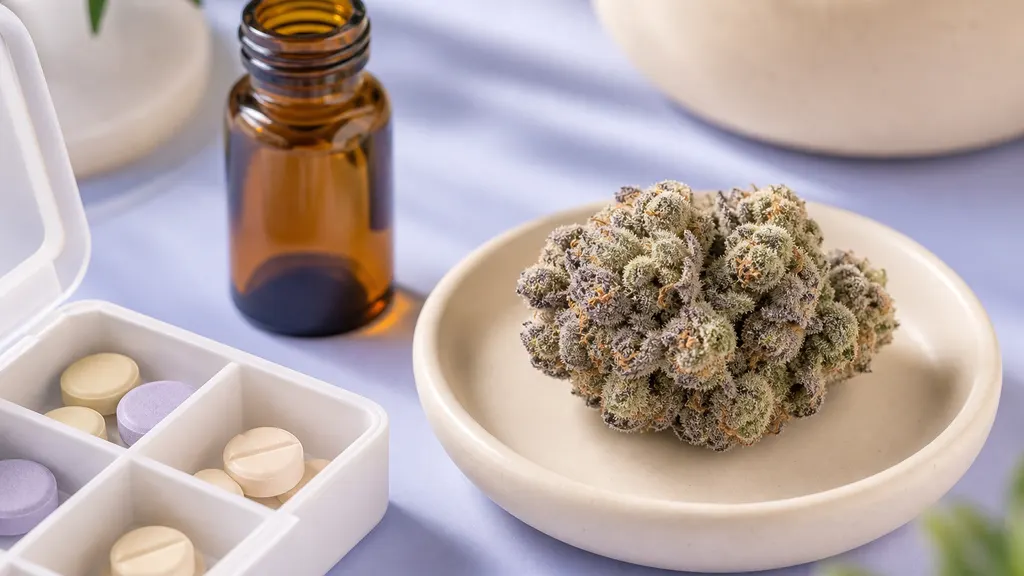
A pill organizer and an amber bottle beside a cream dish holding a frosted cannabis bud

6 min read · Updated November 6, 2026 · WeedDB editors

If you take a prescription, ask your pharmacist or doctor before you mix it with cannabis. Never stop or change a medication on your own because of something you read online, including here. This guide explains why the question comes up, which medication types have documented interactions, and how much of the internet's confidence is really guesswork.

Should you talk to a pharmacist before mixing weed and medication?How does cannabis affect the liver enzymes that process medication?Which medication types have documented interactions with cannabis?Does weed interact with antibiotics?Does it matter whether you smoke, vape or eat it?How reliable is what you read about weed and medications?What can you do with this information?

Should you talk to a pharmacist before mixing weed and medication?

Yes. A pharmacist or the prescriber who wrote your prescription can answer this for you. They know your full medication list, your dose and the reason you take it. A website knows none of those things.

Don't stop, skip or change a medication because of an article. That includes this one. This page is about what researchers have found. It can't tell you what is right for you.

It helps to bring details with you: the product, how you take it (smoked, vaped, edible, oil), how much, and how often. The label guide on reading cannabis labels shows where to find the THC and CBD numbers.

How does cannabis affect the liver enzymes that process medication?

Your liver uses a family of enzymes, called cytochrome P450 or CYP, to break down most prescription drugs. According to two recent reviews, THC and CBD are cleared mainly by three of them: CYP3A4, CYP2C9 and CYP2C19. Many medications use the same ones.

That shared pathway is why researchers ask the question. It is not an interaction on its own. Two things using one enzyme makes an interaction possible to suspect. It doesn't show one happens in a person, or that it matters if it does.

THC and CBD are not identical here. The table shows the enzymes each one is reported to use. CBD touches a wider set, and a 2026 systematic review (abstract only) describes CBD as inhibiting several of these enzymes in laboratory testing. For more on the compounds themselves, see our guide to minor cannabinoids and the list of high-CBD strains.

CannabinoidMain liver enzymesOthers named
THCCYP2C9 (makes 11-OH-THC), CYP3A4UGT enzymes, no specific type named
CBDCYP2C19, CYP3A4CYP1A1, CYP1A2, CYP2C9, CYP2D6, and UGT1A7, UGT1A9, UGT2B7
Both togetherCYP2C9, CYP2C19, CYP3A4Not stated
Enzymes reported for each cannabinoid, according to Caicedo and colleagues (2025). Where the review names no specific enzyme, we leave it that way.
Strains with the most CBD
Sour Space Candy strainHybridSour Space CandyTHC 0–1% · MyrceneCharlotte's Web strainHybridCharlotte's WebTHC 0–1% · MyrceneACDC strainHybridACDCTHC 1–5% · MyrceneMystic Magic strainHybridMystic MagicTHC 7–18% · MyrceneSour Tsunami strainHybridSour TsunamiTHC 1–10% · MyrceneGorilla Mints strainHybridGorilla MintsTHC 10–12%Paradise OG strainHybridParadise OGTHC 8–10%Orange Herijuana strainHybridOrange HerijuanaTHC 10–14%Cannatonic strainHybridCannatonicTHC 4–8% · MyrceneMidnight strainHybridMidnightTHC 7–13% · MyrceneHawaiian Dream strainHybridHawaiian DreamTHC 3–12%Harlequin strainHybridHarlequinTHC 5–15% · Myrcene

Which medication types have documented interactions with cannabis?

According to a 2024 systematic review in Frontiers in Pharmacology, documented interactions cluster in three groups: blood thinners (anticoagulants), anti-seizure drugs (anti-epileptics) and transplant drugs (immunosuppressants). These drugs have narrow margins between a useful dose and a harmful one, and people on them get regular blood tests. That is partly why changes were noticed.

The review searched three databases across all years and screened about 4,600 reports. It included 31, covering 889 people. Of those 31, 18 were case reports or case series, the lowest tier of evidence. A case report shows that something happened to one person. It doesn't tell you how often it happens.

We won't list drug-by-drug verdicts, because the evidence doesn't support them. If you want drug-level detail, the 2024 review's authors run a database called CANN-DIR, and the 2025 review by Caicedo and colleagues includes its own interaction table. Both are written for professionals, so go through your pharmacist.

Medication groupWhat the review reportsEvidence caveat
Blood thinners (anticoagulants)Among the groups where documented interactions clusterMostly case reports and small series
Anti-seizure drugs (anti-epileptics)Among the groups where documented interactions clusterMostly case reports and small series
Transplant drugs (immunosuppressants)Among the groups where documented interactions clusterMostly case reports and small series
Everything elseNot covered as a classAbsence from the review is not a clearance
Where interactions are documented, according to the 2024 systematic review in Frontiers in Pharmacology.

Does weed interact with antibiotics?

Nobody has answered this as a drug class. The 2024 review tracked 57 narrow-margin drugs. One was clindamycin, an antibiotic, and the review found no documented interaction for it. That is an absence of findings. It isn't proof that nothing happens.

Amoxicillin, azithromycin, ciprofloxacin, doxycycline and the other common antibiotics don't appear in either of the two full-text reviews we read. Many sites answer "can I smoke weed on amoxicillin?" with total confidence. They are reasoning from shared liver enzymes, not citing a study.

One antibiotic does have human data: rifampicin. According to the 2025 review, it lowered cannabinoid blood levels in a prescription THC and CBD mouth spray. The arrow points from the antibiotic to the cannabinoids, not the other way round. The review rates that evidence strong and the clinical relevance minor. The same review is inconsistent about what follows: its text recommends a change to the CBD dose, while its summary table recommends monitoring the rifampicin. We report both and don't pick a side. The data also came from a prescription spray, so it can't be carried over to smoked flower or edibles.

You may also see a warning about metronidazole. In the 2025 review, the avoid rating attaches to Syndros, a prescription dronabinol oral solution. It is about that formulation, not about cannabis in general.

AgentWhat the source reportsEvidence ratingClinical relevance
ClindamycinOn the 2024 review's watch list. No documented interaction identified.Not applicableNot applicable
RifampicinLowered cannabinoid levels in a prescription THC and CBD spray (2025 review)StrongMinor
MetronidazoleAvoid rating is attached to Syndros, a prescription dronabinol solution, not to cannabisSee caveatSee caveat
Penicillins, macrolides, fluoroquinolones, tetracyclines, cephalosporinsNot discussed in either review. No evidence located.None existsNone exists
Antibiotics and related anti-infectives in the sourced reviews. Ratings are the sources' own. Our rows end where the sources end.

Does it matter whether you smoke, vape or eat it?

It may, and the interaction research mostly doesn't say. According to the 2025 review, the human studies largely used prescription cannabinoid products at measured doses. Smoked flower and edibles deliver far less predictable amounts, so findings from a pharmaceutical spray can't simply be read across.

Edibles also run on a slower clock, which our guide to how long edibles take explains. Whether that changes anything for a given medication is a question for your pharmacist, not something the research has settled.

How reliable is what you read about weed and medications?

A lot of it jumps from an enzyme to a conclusion. That THC, CBD and many drugs share a pathway is documented. That they therefore interact in a person is, for most drugs, not published anywhere we could find. The two claims often get presented as one.

Three habits are worth watching for. First, writers say "unsafe" or "safe" about a specific drug when the evidence is silent. Silence means unstudied, not disproven. Second, they state which drug affects which, though the direction is often unknown. Third, they treat "an interaction exists" as "it matters." The rifampicin entry above is rated strong evidence and minor relevance at the same time.

Interaction checkers deserve the same caution. They can be a useful starting point for a pharmacist, but their per-drug verdicts often go further than the reviews do. Health Canada's information for health care professionals on cannabis says CBD may increase THC effects by inhibiting THC metabolism in the liver. It doesn't set out a medication-by-medication guide.

Unstudied is not the same as safe

No source we read says any combination is safe, and none says any is dangerous for most drugs. For nearly all medications, the honest answer is that nobody has looked. Your pharmacist has the information that decides it: your drugs, your dose and your reasons.

What can you do with this information?

Use it to ask better questions. You don't need to quote a study. Tell your pharmacist what you use, how, how much and how often, and let them look at the full picture.

Keep your own record handy if you use cannabis regularly. Our guides on THC drinks and weed and caffeine show how little is studied even for everyday combinations. Medications are a bigger question, with more at stake, and they deserve a professional's answer.
Sources: doi.org, doi.org, doi.org, canada.ca

Common questions

Should I talk to my pharmacist or doctor before using weed with a prescription?

Yes. A pharmacist or the prescriber who wrote your prescription knows your full medication list, your dose and the reason you take it. Never stop or change a medication on your own because of an article. It helps to describe the product, how you use it, how much and how often.

Does weed interact with antibiotics?

No authoritative source we found covers cannabis and antibiotics as a class. A 2024 systematic review tracked 57 narrow-margin drugs, including the antibiotic clindamycin, and found no documented interaction for it. That is unstudied rather than settled. A pharmacist can answer it for your prescription.

Which medications have documented interactions with cannabis?

According to a 2024 systematic review, documented reports cluster in blood thinners, anti-seizure drugs and transplant drugs. These drugs have narrow safety margins and routine blood monitoring. Most of the 31 included reports were case reports or small series, the lowest tier of evidence.

What are CYP450 enzymes and why do they come up?

CYP450 is a family of liver enzymes that break down most prescription drugs. According to two recent reviews, THC and CBD are processed mainly by CYP3A4, CYP2C9 and CYP2C19, which many medications also use. Sharing a pathway is why researchers ask the question. It is not evidence that a combination does anything.

Does rifampicin interact with cannabis?

Rifampicin is the one antibiotic with human data we located. According to a 2025 review it lowered cannabinoid blood levels in a prescription THC and CBD spray, so the antibiotic acted on the cannabinoids. The review rated the evidence strong and the clinical relevance minor. The finding does not carry over to smoked or edible cannabis.

Is CBD different from THC for drug interactions?

Somewhat. According to a 2025 review, CBD is processed mainly by CYP2C19 and CYP3A4 and touches a wider set of enzymes, while THC runs largely through CYP2C9. Most published interaction reports involve prescription products at measured doses, not consumer products.

Does the form matter, like edibles versus smoking?

It may, and the interaction research mostly does not answer it. According to the 2025 review, human studies largely used prescription cannabinoid products at measured doses. Smoked flower and edibles deliver less predictable amounts, so findings from a pharmaceutical spray cannot simply be read across to them.

Can cannabis replace a medication I take?

No. This guide never suggests it. Do not stop or change a prescription on your own. Any decision about your medication belongs with your prescriber and your pharmacist, who know your history and your dose.

Keep reading

All guides
A cream mug of black coffee beside a lavender dish of frosted cannabis buds and a small plate of coffee beansGuideWeed and caffeine: what the evidence actually showsWeed and caffeine have been tested together in people only once. A small 2025 trial found minimal changes to THC's effects, task performance and metabolism. Most confident claims online rest on animal studies, some of which didn't use caffeine at all. In Canada, caffeine is not generally allowed in cannabis products.Read it Cannabis buds under floating labels for CBG, CBN, CBC, THCV and THCAGuideMinor cannabinoids: CBG, CBN, CBC, THCV and THCA explainedMinor cannabinoids are the cannabinoids in cannabis other than THC and CBD, called minor because of how little a typical plant makes, not how strong they are. In Canada they all fall under the Cannabis Act, Health Canada names CBN and THCV as intoxicating, and labels only have to show THC and CBD.Read it A sunny cannabis farm with a wooden CBD sign and a barn behind the plantsGuideHigh-CBD strains: CBD-rich cannabis explainedHigh-CBD strains are cannabis varieties that test high in CBD (cannabidiol) and often low in THC. In Canada, CBD products are regulated as cannabis under the Cannabis Act, and labels show Total CBD and Total THC so you can read the ratio.Read it A young woman eating a gummy beside a bowl of colourful gummies and baked treatsGuideHow long do edibles take to kick in?Health Canada says edibles can take 30 minutes to 2 hours to start working, with the strongest effects 2 to 4 hours in and effects lasting 4 to 8 hours. The wait is why the standard advice is to start low, go slow and not take more too early.Read it Cans of cannabis drinks and a glass of sparkling drink with fruit and iceGuideTHC drinks in Canada: how cannabis beverages workCannabis beverages have been legal in Canada since October 2019, and each container can hold no more than 10 mg of THC. They are classed as edibles, so they act slowly: Health Canada says effects can start 30 minutes to 2 hours after drinking.Read it A Canadian cannabis jar with its label parts called out: the THC symbol, THC and CBD content, net weight, packaged date, lot number and the Health Canada warningGuideHow to read a cannabis label in CanadaEvery legal cannabis product in Canada has to show its Total THC and Total CBD, the red THC symbol, a yellow health warning, a lot number, a packaging date and an excise stamp for your province. Total THC is the number to compare, and it's shown in mg/g for flower and in mg per piece and per package for edibles.Read it Three glass jars of frosty cannabis buds on a wooden counter beside a small digital scale and a glass beakerGuideWhat does the THC percentage on weed actually mean?A THC percentage is a calculated share of a flower's weight, worked out from one lab sample of one lot. It is useful, but it is one value drawn from a plant that varies, and we could not find a source that shows what it predicts about how a product will feel.Read it A healthy green cannabis plant in a pot beside a small clip-on fan, a handheld magnifier and a humidity gauge on a wooden shelfGuideCannabis pests, mould and bud rot: why it starts insideA Canadian government guide says bud rot commonly starts in the interior of the bud, where humidity is highest and air movement is lowest. That makes it an environment problem first. Here is what the sources establish about pests and mould on a growing plant, and where they stay silent.Read it