People search this hoping for a winner. The research doesn't give one. What it gives is a handful of fair comparisons, a lot of gaps, and one big difference in how Canada's official guidance treats the two. Here's what was measured, what wasn't, and where the popular claims run ahead of the evidence.
Is weed worse than alcohol?
No single study answers that, because the two have rarely been measured on the same scale. Four comparisons exist in one unit each: crash risk, dependence, acute lethality and cost to Canada. They give different answers, and none covers long-term organ damage, where we found no head-to-head study.
So this guide won't rank them. It lays out what each source found and leaves the decision, and any medical question, to you and your doctor or pharmacist.
How does weed compare with alcohol for driving?
A 2016 meta-analysis in Addiction pooled 21 studies and put the odds of a crash after cannabis intoxication at 1.36. Its authors placed that near a blood alcohol content of 0.04 to 0.05, and said the increase was unlikely to be of the magnitude associated with alcohol. They also noted that selection effects may limit how causally the pooled estimates can be read.
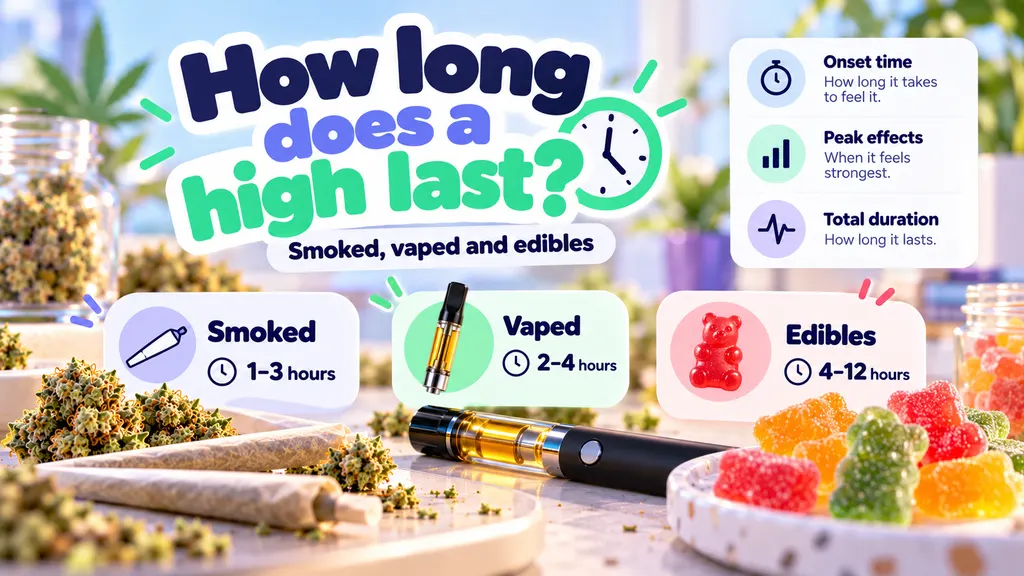
For alcohol, the same paper cited an estimated relative risk of 7.5 for crashes involving fatalities. That doesn't make cannabis driving fine. Canada's cannabis guidelines say to wait at least six hours before driving, and that it may need to be longer. If you want the timing side, see how long a high lasts.
If you're thinking about using both, that has its own risks and we don't cover it here. Don't drive after either.
| Exposure | What was reported |
|---|---|
| Cannabis, random effects | Odds ratio 1.36 (95% CI 1.15 to 1.61). Adjusted for publication bias: 1.22 (1.10 to 1.36). |
| Authors' stated equivalent | A blood alcohol content of 0.04 to 0.05 |
| Alcohol, fatal crashes | Estimated relative risk of about 7.5 |
| Cannabis, other published range | 1.3 to 3-fold, and about 4-fold in one Canadian case-crossover study |
Which one is more addictive?
One large US survey (NESARC) measured both with the same DSM-IV instrument. Among people who had ever used, 22.7% of alcohol users met dependence criteria, against 8.9% for cannabis. Nicotine was 67.5% and cocaine 20.9%.
Timing differed too. Half of the cannabis cases that developed did so within about five years of first use, versus about 13 years for alcohol. One survey, one instrument and one country is a useful comparison, not a final word. It also says nothing about how severe the dependence was.
If you're thinking about cutting back, our guide to a tolerance break explains how tolerance works.
| Substance | Cumulative probability | Half of cases by |
|---|---|---|
| Nicotine | 67.5% | About 27 years |
| Alcohol | 22.7% | About 13 years |
| Cocaine | 20.9% | About 4 years |
| Cannabis | 8.9% | About 5 years |
Is weed or alcohol linked to cancer?
The international cancer agency IARC lists alcohol consumption as a Group 1 human carcinogen, with cancers named at seven sites: oral cavity, pharynx, larynx, oesophagus, colorectum, liver and female breast.
Cannabis smoking has no IARC classification. That means it hasn't been evaluated, not that it was evaluated and cleared. IARC listed it as a candidate in its 2025 to 2029 priorities. Don't read a missing label as good news.
What does Canada's official guidance say about each?
This is the clearest difference. The CCSA's 2023 alcohol guidance gives a weekly numeric continuum. The 2017 Lower-Risk Cannabis Use Guidelines give ten behavioural recommendations and no dose figure at all.
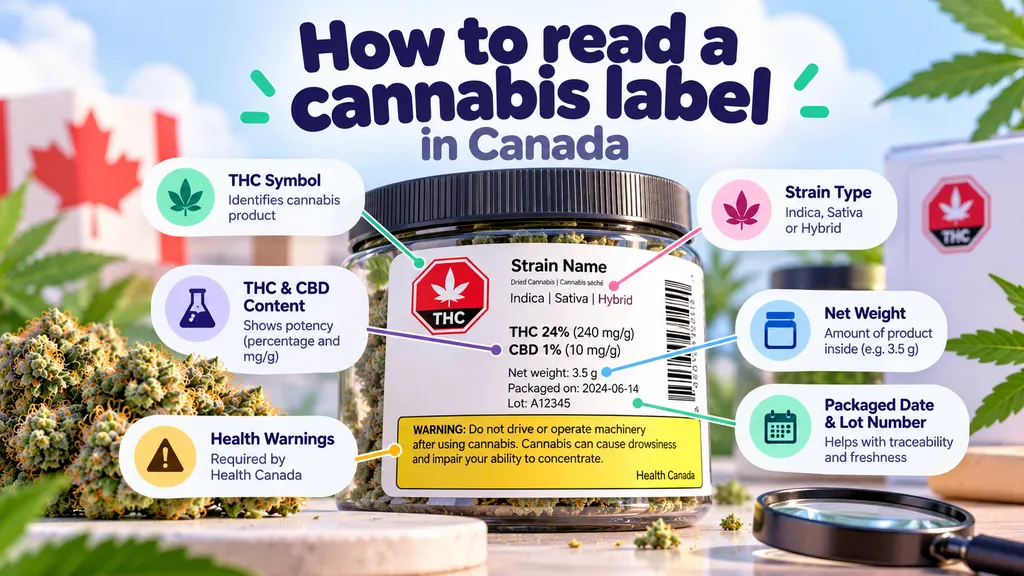
You can't compare a number with the absence of a number. That's a gap in the research, and it's why "how much is too much" has an answer for alcohol and a looser one for cannabis. For more on what product labels do tell you, see reading cannabis labels.
| Alcohol (CCSA, 2023) | Cannabis (Fischer et al., 2017) | |
|---|---|---|
| Form | A numeric weekly continuum | Ten graded behavioural recommendations |
| Dose threshold | 0 drinks, 2 or fewer, 3 to 6, or 7 or more per week | None |
| How risk is named | At 3 to 6 a week, risk of several cancers, including breast and colon, increases. At 7 or more, risk of heart disease or stroke increases significantly. | By frequency, not dose: "daily or near-daily" use is the concern |
| Driving and occasions | More than 2 drinks on an occasion is linked to more harm to self and others | Wait at least 6 hours before driving; impairment typically clears within about 3 to 6 hours |
What do alcohol and cannabis cost Canada?
In 2017, substance use cost Canada almost $46.0 billion, according to the CCSA-led costs and harms report. Alcohol accounted for about $16.6 billion, or 36.2% of the total, and $454.86 per person. Cannabis accounted for about $3.24 billion, or 7.0%, and $88.64 per person.
Don't turn that into a harm ratio per user. The groups using each substance differ in size, and cannabis's share leaned heavily on criminal justice costs under the law of the time. The report shows $1.62 billion of cannabis costs there, against $547 million for lost productivity.
Can you die from either one?
Alcohol has an established lethal dose. For cannabis, a 2015 risk assessment in Scientific Reports found no identifiable human mortality dose-response data. That left psychotropic effects as its only human endpoint, and its authors called the results preliminary because of high uncertainty in the data.
Absence of a measured lethal dose isn't proof that none exists. Treat that one as unverified. If you've had a rough time with too much THC, see our guide to greening out.
How reliable is the claim that weed is safer than alcohol?
Less reliable than its popularity suggests. Here's where it tends to go wrong.
The harm score most often cited comes from a 2010 Lancet exercise in which experts scored 20 drugs against 16 criteria in a panel. Alcohol scored 72 overall, first of 20. That's expert judgment, not a measurement, and we haven't quoted a cannabis score because we couldn't verify one.
A missing cancer classification is not a clean bill of health, as above. And the myth that weed stays in your system for 30 days while alcohol clears in hours mixes up impairment with detection. Our drug tests guide explains the difference.
The opposite error shows up too. Cannabis does not impair driving "just as badly" as alcohol by the pooled crash numbers, but it does impair. Nothing here is a reason to skip the basics: start low, go slow and don't drive.
Switching from one to the other is a different question. Nothing we read measured it, so it's unverified. If you're weighing a change in your own drinking or use, talk with a doctor or pharmacist.
Sources: doi.org, doi.org, doi.org, doi.org, doi.org, ccsa.ca, monographs.iarc.who.int