StrainsTerpenesGuidesDispensaries
WeedDB
StrainsTerpenesGuidesDispensaries

Get new strain guides and deals

Yes, email me new strain guides, deals and WeedDB news. I can unsubscribe at any time. Privacy policy

WeedDB
StrainsIndicaSativaHybridTerpenesGuidesAboutContactPrivacyTermsDispensaries
19+ only. Please consume responsibly. © 2026 WeedDB
Home›Guides›Grow lights and growing medium: what the trials measured
Guide

Grow lights and growing medium: what the trials measured

Controlled trials show that more light raises how much flower a plant makes, while light colour and growing medium have not been shown to change potency. Soil, coco and rockwool differ mainly in how they hold water. Here is what the research measured, and what it did not.

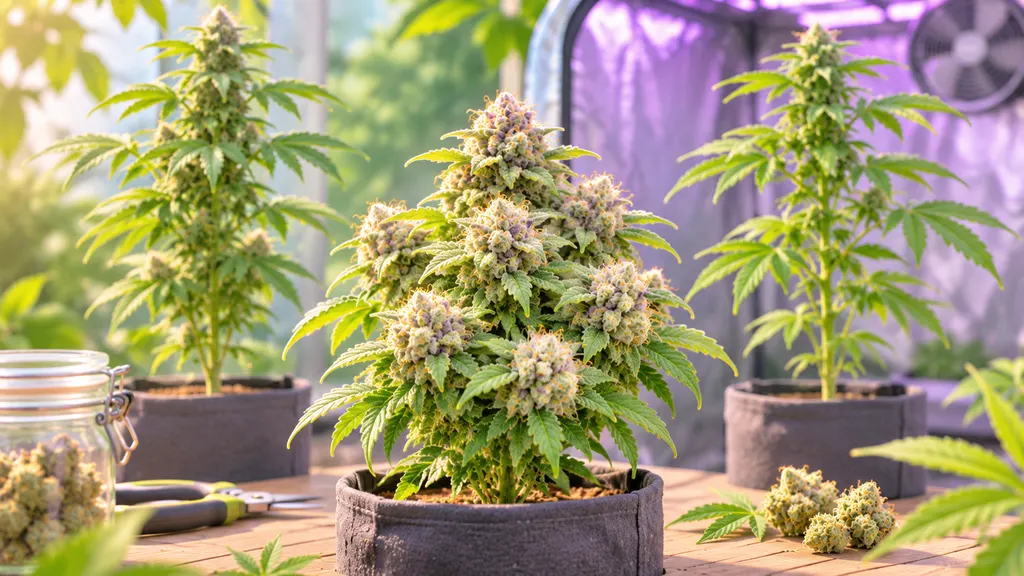
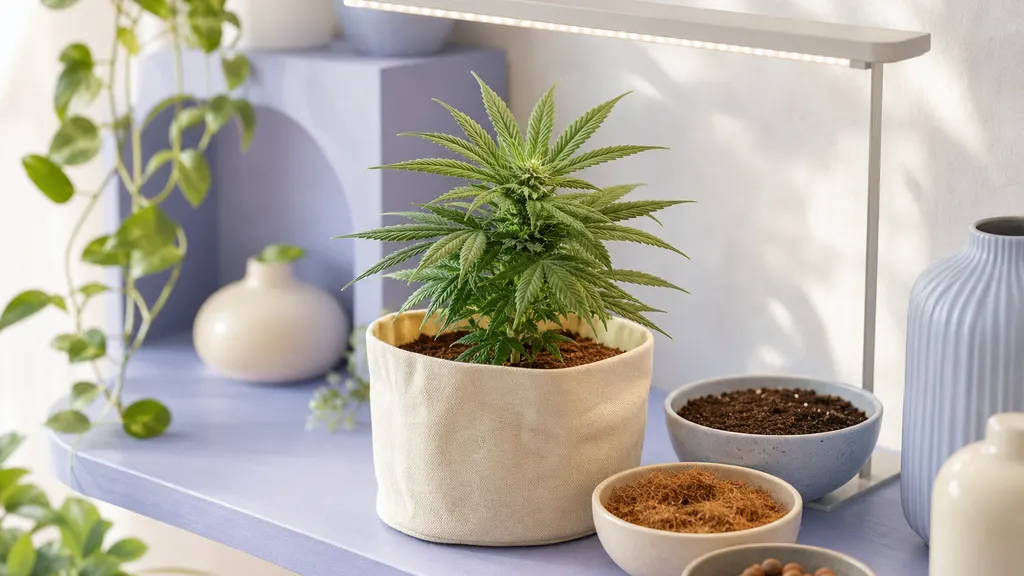
A young cannabis plant in a fabric pot under a slim LED grow light, with bowls of soil, coco coir and clay pebbles

6 min read · Updated November 11, 2026 · WeedDB editors

Most grow advice comes from people selling lights or soil. Published trials say something simpler: light and medium change how much flower you get, not how strong it is. Here is what was measured, what was not, and how to choose a setup for a small home grow.

How much light does a cannabis plant need?Does more light make weed stronger?LED, HPS or something else: does it matter?Does light colour or UV matter?Is a 12/12 light schedule necessary?Soil, coco or hydro: which growing medium is best?Does growing medium change potency?What matters more than light or medium?How reliable is grow advice?

How much light does a cannabis plant need?

More than most home setups deliver, and the response is close to linear. In one indoor trial, raising canopy light from 600 to 1,000 µmol per square metre per second raised dry flower from 27.6 to 44.7 g per plant. The authors estimated every extra 100 µmol of daily light added about 4.6 g per plant.

The plants at 1,000 were still on the straight part of the curve, so that trial did not find a ceiling. We will not give you a target number either. No peer-reviewed home-grow recommendation turned up, and a figure with no source is just marketing.

One thing worth knowing: that trial used one cultivar, three plants per light level, and a licensed producer funded it. Treat it as a strong hint, not a law. If you are new to growing, start with our overview of growing weed in Canada.

Canopy light (µmol m⁻² s⁻¹)Dry flower (g per plant)Fresh flower (g per plant)
600 (control)27.6143
80037.2191
1,00044.7218
Light level and flower yield for the cultivar 'Meridian' (Llewellyn et al. 2022, three plants per level). Only 600 versus 1,000 was a statistically significant gap.

Does more light make weed stronger?

No. The same 2022 trial found no light-level or spectrum effect on the cannabinoid concentration of the flower. An earlier trial agreed: across a 4.5-fold range in yield, it found no light-level effects on the potency of any measured cannabinoid.

That means more light buys more grams at about the same percentage. If a brand says its light makes stronger weed, ask which trial shows it. For what the numbers on a label actually mean, see reading cannabis labels.

LED, HPS or something else: does it matter?

Mostly for your power bill. Watts measure the electricity a fixture draws. They do not measure the light your plants receive. In one published comparison, fixture efficacy ran from roughly 1.7 to 2.5 µmol of light per joule, so two lamps with the same wattage can give your plants quite different amounts of light.

That is why "watts per square foot" is a weak rule. Look for a maker who publishes light output (PPFD) at a stated distance and area, and ask how much of it reaches the canopy. We could not source a controlled head-to-head of LED against HPS for flower yield, so we will not name a winner.

Does light colour or UV matter?

Less than the marketing suggests, and the studies do not fully agree. A trial on a hemp cultivar found a steady 12% drop in yield as the blue share rose from 4% to 20%, with no effect on CBD or THC concentration. A second trial on a high-THC cultivar found the highest THC concentration under blue light, but a much lower yield per plant.

Both used research setups, not typical home lights. Neither shows blue light as a reliable way to get stronger flower.

UV has the same story. In one controlled trial, extra UVA, and UVA with UVB, did not change flower cannabinoid concentration or any above-ground biomass measure. That is one trial on one cultivar, so call the "UV boosts THC" claim unproven rather than disproven.

Is a 12/12 light schedule necessary?

Not for every cultivar. Photoperiod plants flower when the dark period gets long, and 12 hours light and 12 dark is the usual switch. A trial that tested nine light schedules on three cultivars concluded that 12/12 being best for all lines is incorrect.

Longer light during flowering (14 hours instead of 12) raised plant biomass in all three. The high-THC cultivars lost some THC concentration, and one still ended up with similar total cannabinoid yield. The results were cultivar by cultivar, so a longer day is not a free upgrade.

Autoflowering plants skip this question. They flower on age, not on day length, which is why they suit beginners. See our autoflower strains guide.

Soil, coco or hydro: which growing medium is best?

We found no controlled cannabis trial that ranks them on flower yield, and a 2025 review calls comparison of growing media underexplored. So choose on how the medium behaves, not on a yield promise.

Soil and peat mixes buffer mistakes, because they hold nutrients and release them slowly. Coco coir sits in the middle. Rockwool and hydroponic setups are close to inert, so the plant gets what you put in the nutrient solution and nothing more. That gives you control, but it also leaves less room for error.

The big practical difference is water. In one trial cited by a 2025 review, rockwool held 2.6 L at container capacity with 79% readily available to the plant. Coir held 1.4 L with 14%, and a peat-perlite mix 1.04 L with 9%. How often you water depends on that, more than on any brand claim.

MediumTypical pHTotal porosityHolds nutrients (CEC)
RockwoolAbout 7.591 to 96%Almost none
Peat3.0 to 5.0 (5.5 to 6.5 once limed)80 to 95%100 to 200 cmol(+)/kg
Perlite7.0 to 7.5Not givenAlmost none
Coco coir5.2 to 6.8Not givenHigh
Common growing media, from a 2025 review of soilless media (Malík and Tlustoš). CEC is how well a medium holds nutrients. Coco figures were not given as numbers in the review, so they are left out.

Does growing medium change potency?

On the evidence found, no. Two substrate trials in the same 2025 review reported CBD of about 6% across peat, a peat and green-fibre blend and coir, with no statistical differences. A second set of 3.3 to 4.9% across rockwool, peat-perlite and coir also showed no significant effect.

Medium can change yield, though, and it depends on the plant. In one trial on two genotypes, one genotype's flower weight more than doubled between its best and worst substrate (8.56 vs 3.84 g per plant). The other barely moved (9.19 vs 7.90 g). We only had the abstract of that paper, so treat the figures as a rough illustration.

What matters more than light or medium?

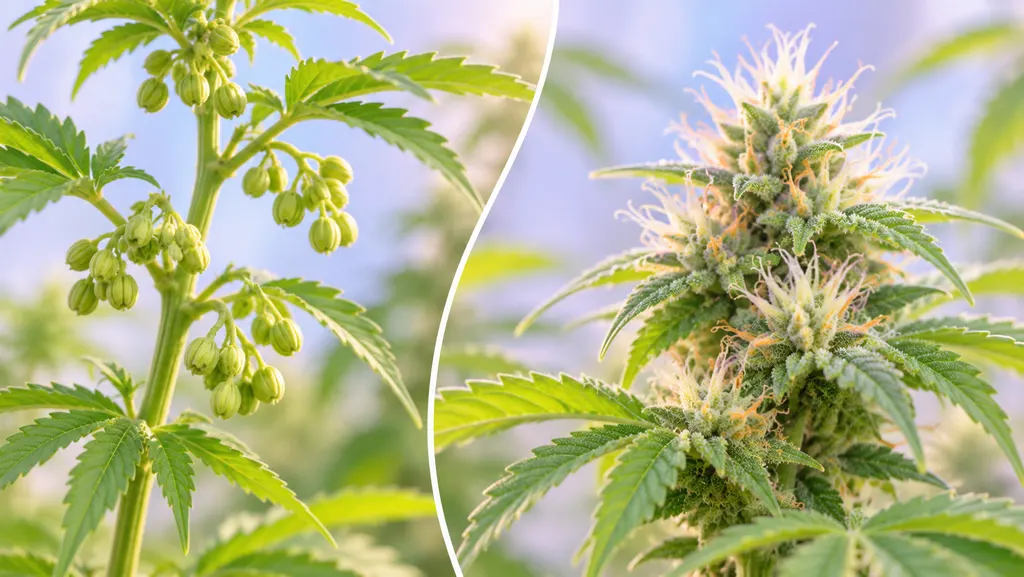
The plant you start with. Potency is largely driven by genetics, while light and medium move grams. Pick your seeds first, and read what a phenotype is so a surprise in your tent does not catch you off guard.

Also check male vs female plants, since a male in a four-plant limit is a real loss. Canada's federal limit is four plants per household, Quebec bans home growing, and Manitoba allows indoor growing only. Our seed guide covers legal sources.

How reliable is grow advice?

Check any claim against what a controlled trial actually measured. These five come up often.

  • Light wattage as a target: wattage counts electricity, not photons. Fixtures of equal wattage delivered different light in published tests.
  • UV makes it stronger: one trial found no effect. Unproven, not disproven.
  • Blue or purple light makes it stronger: two trials disagree, and one found no concentration effect at all.
  • Hydro beats soil: no controlled head-to-head on flower yield was found. Unverified.
  • 12/12 is the rule: a nine-schedule trial says it is not best for every cultivar.
Strains people look up most
Maui Wowie strainSativaMaui WowieTHC 16–28% · MyrceneBlue Dream strainHybridBlue DreamTHC 17–24% · MyrceneSour Diesel strainSativaSour DieselTHC 18–24% · CaryophylleneApples and Bananas strainHybridApples and BananasTHC 20–30% · CaryophylleneLemon Cherry Gelato strainHybridLemon Cherry GelatoTHC 19–29% · CaryophylleneOG Kush strainHybridOG KushTHC 19–26% · MyrceneGorilla Glue strainHybridGorilla GlueTHC 18–30% · CaryophylleneSuper Boof strainHybridSuper BoofTHC 26–32% · MyrceneGMO strainHybridGMOTHC 22–28% · CaryophylleneRuntz strainHybridRuntzTHC 19–30% · CaryophylleneJack Herer strainSativaJack HererTHC 15–22% · TerpinoleneGelato strainHybridGelatoTHC 18–26% · Caryophyllene

Sources: doi.org, doi.org, doi.org, doi.org, doi.org, doi.org, doi.org
Common questions

How much light does a cannabis plant need?

One indoor trial raised canopy light from 600 to 1,000 micromoles per square metre per second, and dry flower rose from 27.6 to 44.7 grams per plant. The plants were still on the linear part of the response curve, so no ceiling was found.

Do stronger grow lights make stronger weed?

No. The intensity trials reviewed here measured cannabinoid concentration and found no effect from light level. More light gave more flower at about the same percentage.

What is the difference between PPFD and watts?

PPFD counts the useful photons landing on an area each second. Watts measure the electricity a fixture draws. In one published comparison, fixture efficacy ranged from about 1.7 to 2.5 micromoles per joule, so equal wattage can mean different light.

Does the colour of a grow light matter?

Less than marketing suggests. One trial found yield fell about 12 percent as blue light rose from 4 to 20 percent, with no change in THC or CBD concentration. Another found higher THC concentration under blue but lower yield.

Does UV light increase THC?

Not in the one controlled trial found. Extra UVA, and UVA with UVB, did not change flower cannabinoid concentration. That is a single trial on one cultivar, so the claim is unproven rather than disproven.

Do I have to use a 12/12 light schedule?

It is standard practice, but one trial on three cultivars concluded it is not best for all of them. Longer light in flowering raised biomass in all three, while lowering THC concentration in the high-THC cultivars. Autoflowers do not need it.

Is hydroponics better than soil for cannabis?

No controlled trial found compares them directly on flower yield, and a 2025 review calls growing media comparison underexplored. The media differ most in how much water the plant can use, which affects how often you water.

Does growing medium change how strong the weed is?

Not on the evidence found. Two substrate trials summarised in a 2025 review reported no significant differences in cannabinoid concentration across peat, coir, rockwool and peat-perlite mixes.

Keep reading

All guides
A small grow tent with a few cannabis plants in the corner of a cozy bedroomGuideGrowing weed in Canada: the 4-plant rule by provinceThe federal Cannabis Act lets adults grow up to four cannabis plants per residence for personal use, but each province sets its own extra rules. Quebec bans home growing outright, and Manitoba only allowed it, indoors, from May 1, 2025. Seeds and plants must come from a legal source.Read it Small autoflowering cannabis plants in fabric potsGuideAutoflower strains: what they are and how they differAutoflowering cannabis switches from growing to flowering based on the plant's age, not on a change in daylight, because it carries genetics from Cannabis ruderalis. It stays smaller and finishes faster than a photoperiod plant, which usually means a smaller harvest.Read it A male cannabis plant with pollen sacs beside a flowering female plantGuideMale vs female weed plants: how to tell them apartFemale cannabis plants grow pistils and form the resinous buds people smoke, while males grow small pollen sacs and produce no usable flower. You can tell them apart when the plant shows its pre-flowers, usually a few weeks into growth, and growers remove males to get seedless buds.Read it Cannabis seeds falling from plants into a wooden bowlGuideWeed seeds in Canada: is it legal to buy them?Yes. Adults can legally buy cannabis seeds in Canada from federally licensed sellers and provincially authorized retailers. Seeds count toward your possession limit: one seed equals 1 g of dried cannabis under Schedule 3 of the Cannabis Act, so 30 seeds is the public maximum.Read it A Canadian cannabis jar with its label parts called out: the THC symbol, THC and CBD content, net weight, packaged date, lot number and the Health Canada warningGuideHow to read a cannabis label in CanadaEvery legal cannabis product in Canada has to show its Total THC and Total CBD, the red THC symbol, a yellow health warning, a lot number, a packaging date and an excise stamp for your province. Total THC is the number to compare, and it's shown in mg/g for flower and in mg per piece and per package for edibles.Read it Three cannabis plants of different colours and shapes side by side with a magnifying glassGuideWhat does pheno mean? Phenotypes, cuts and why one strain name can mean different plants"Pheno" is short for phenotype: the physical and chemical traits a plant actually shows, such as its smell, structure and cannabinoid levels. Two seeds from the same cross can grow into different phenotypes, which is why one strain name can cover several different plants.Read it A healthy green cannabis plant in a pot beside a small clip-on fan, a handheld magnifier and a humidity gauge on a wooden shelfGuideCannabis pests, mould and bud rot: why it starts insideA Canadian government guide says bud rot commonly starts in the interior of the bud, where humidity is highest and air movement is lowest. That makes it an environment problem first. Here is what the sources establish about pests and mould on a growing plant, and where they stay silent.Read it A small magnifying loupe resting beside a young cannabis plant, with a few fresh cuttings and a pair of fine scissors on a wooden benchGuideSexing cannabis plants: pre-flowers and hermiesSexing is the step that decides whether a cannabis plant ever becomes the flower people buy: only unpollinated females do. Pre-flowers at the nodes show the sex, and a hermaphrodite shows both. What pollination costs in potency has not been measured in the sources we could verify.Read it