StrainsTerpenesGuidesDispensaries
WeedDB
StrainsTerpenesGuidesDispensaries

Get new strain guides and deals

Yes, email me new strain guides, deals and WeedDB news. I can unsubscribe at any time. Privacy policy

WeedDB
StrainsIndicaSativaHybridTerpenesGuidesAboutContactPrivacyTermsDispensaries
19+ only. Please consume responsibly. © 2026 WeedDB
Home›Guides›Why does weed make your eyes red? What the research says
Guide

Why does weed make your eyes red? What the research says

THC widens the small blood vessels on the white of the eye, so more blood flows through them and they show. A 2024 review calls the effect acute and transient. No study has timed how long it lasts, and the hour counts you see online have no source.

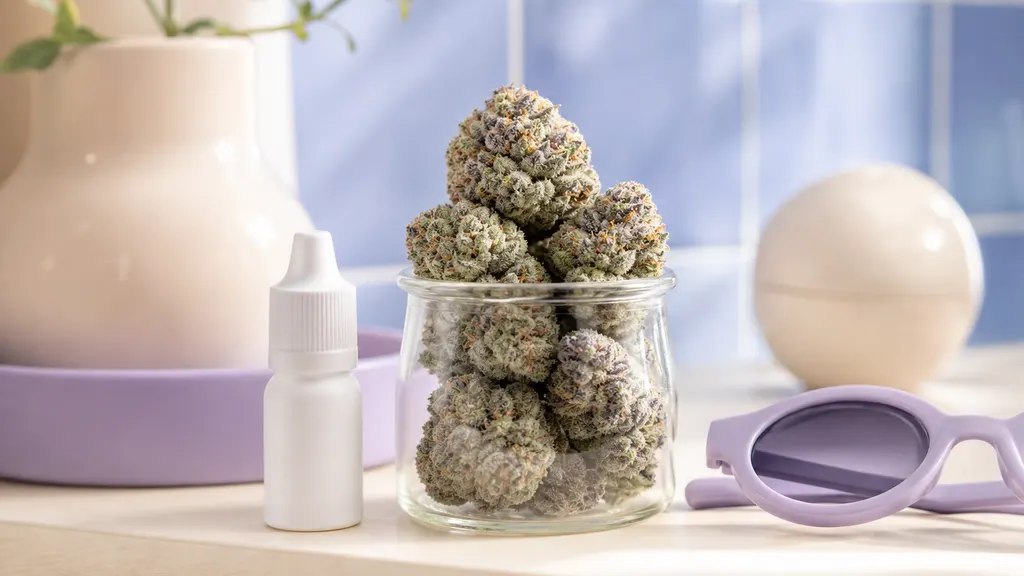
Eye drops and lavender sunglasses beside a glass jar of frosted cannabis buds on a pastel bathroom shelf

5 min read · Updated November 14, 2026 · WeedDB editors

Red eyes are the most famous side effect of cannabis. The reason is simple: THC makes the tiny blood vessels on the surface of your eye wider. What's less simple is everything else you'll read online, like how long it lasts or what clears it. Here's what the research actually says, and where it runs out.

Why does weed make your eyes red?Is it the smoke, or the cannabis?How long do red eyes last?Do eye drops get rid of weed eyes?What has research measured about pressure inside the eye?Do red eyes mean the weed was strong?How reliable is the evidence on cannabis and red eyes?

Why does weed make your eyes red?

The white of your eye is covered by a thin, clear layer called the conjunctiva. It's full of tiny blood vessels. When THC widens them, more blood flows through and they become visible. That's the red or bloodshot look.

A 2024 review in Clinical Ophthalmology describes this as an acute, transient effect. It says THC induces vasodilation by binding cannabinoid receptors in the eye. Vasodilation just means the vessels open wider. The same review notes that CB1 receptors have been found in the cornea, while the role of CB2 there is still debated.

ClaimStatus
Short-lived redness from THC widening the vessels of the conjunctiva, through cannabinoid receptorsStated in a peer-reviewed review
CB1 receptors on the corneaStated. CB2 in the cornea "remains controversial"
How many receptors sit in the conjunctivaNot stated
How soon it starts, and how long it lastsNot stated
Smoked compared with eatenNot stated
How much THC causes how much redness in peopleNot stated. Animal studies suggest it depends on dose
What the 2024 review (Bondok et al.) does and does not say about red eyes.

Is it the smoke, or the cannabis?

The cannabis. The mechanism in the research is about blood vessels and receptors, not irritation. That means it doesn't need smoke at all.

Smoke in a closed room is a real irritant, and it can add to the redness. But it isn't the cause the literature gives. For the timing of a high itself, see our guide to how long a high lasts.

What about edibles? It fits the mechanism: a vessel effect doesn't need smoke to reach your eye. But we found no controlled study comparing smoked and eaten cannabis for eye redness. So treat this as reasoning from the mechanism, not a measured result. For how fast edibles start, see how long edibles take to kick in.

How long do red eyes last?

Nobody has timed it. The 2024 review calls the effect acute and transient, and gives no start time or length. That's the honest answer.

You'll still see "2 to 3 hours" or "up to 12 hours" on plenty of pages. We couldn't trace those to a measurement of redness. Some of the numbers you'll see come from a different line of research: studies of pressure inside the eye, which never measured redness. A figure for one thing was borrowed for another.

So what can you say? It's temporary, it tends to follow when you consume, and the exact length varies from person to person. Anything more precise is a guess.

Figure you may seeWhat it was measuringSource we could find
"4 to 5 hours"Pressure inside the eye, after a mean dose of 103 mg of THC (Cohen, 1976, as reported by Bondok et al.)A pressure study, not a redness study
"2 to 3 hours" or "up to 12 hours"RednessNone found
Where duration numbers online come from.

Do eye drops get rid of weed eyes?

We found no controlled study of eye drops for cannabis-related redness. Drops that narrow blood vessels act on the same vessels that widened, so the idea is plausible. But plausible and tested are different things.

We won't name a product or a dose. If your eyes are painful, only one eye is red, or your vision changes, that's not a weed question. Ask a doctor or pharmacist, or see an eye-care professional.

What has research measured about pressure inside the eye?

This is the part people most often get wrong, so here are the facts only. Since 1971, small studies have measured short-term changes in pressure inside the eye after cannabis. They measured pressure, not redness, and they don't tell you anything about your own eyes.

The American Academy of Ophthalmology does not recommend cannabis for glaucoma. If you have an eye condition, talk to your eye doctor before changing anything. Don't swap cannabis in for, or add it to, what they told you to do.

StudyPeopleHow takenWhat was reported
Hepler & Frank, 1971 (a short letter)11Smoked, 2 g at 0.9% THCReadings at one hour differed by person, from a small rise to a drop of up to 45%. No average was given. The authors called it preliminary data
Cohen, 197630Inhaled or oralPressure fell by 30% in 7 of 11 people with open-angle glaucoma, lasting 4 to 5 hours
Jay & Green, 198323Drops, 1% THCNo difference from placebo
Tomida et al., 20066Under the tongue5 mg of THC reduced pressure temporarily. 40 mg of CBD caused a transient increase
Early pressure studies, as reported by Bondok et al. (2024). These are measurements, not recommendations.

Do red eyes mean the weed was strong?

Not reliably. The review says animal studies suggest the effect depends on dose, but we found no human study that links dose to redness. So red eyes can't tell you how strong a product was or how impaired someone is. For strength, read the label: our guide to reading cannabis labels shows how.

Red eyes are also a visible sign, and a fairly consistent one. The review calls them one of the most sensitive objective signs of cannabis use and cites one study where 94% of drug-impaired drivers with a positive THC blood test had them. That's a group of people stopped by police, so don't read it as a share of all users.

How reliable is the evidence on cannabis and red eyes?

The mechanism is well attributed. Almost everything else is thin. One peer-reviewed review covers it in a few sentences, the 1971 pressure study is a letter about eleven people, and no paper gives a duration.

That doesn't mean smoke has nothing to do with it, or that eye drops don't work, or that red eyes are harmless. It means the studies haven't been done. Where they haven't, we'd rather tell you than guess. Our greening out guide takes the same approach to the effects people most often worry about.
Strains people look up most
Maui Wowie strainSativaMaui WowieTHC 16–28% · MyrceneBlue Dream strainHybridBlue DreamTHC 17–24% · MyrceneSour Diesel strainSativaSour DieselTHC 18–24% · CaryophylleneApples and Bananas strainHybridApples and BananasTHC 20–30% · CaryophylleneLemon Cherry Gelato strainHybridLemon Cherry GelatoTHC 19–29% · CaryophylleneOG Kush strainHybridOG KushTHC 19–26% · MyrceneGorilla Glue strainHybridGorilla GlueTHC 18–30% · CaryophylleneSuper Boof strainHybridSuper BoofTHC 26–32% · MyrceneGMO strainHybridGMOTHC 22–28% · CaryophylleneRuntz strainHybridRuntzTHC 19–30% · CaryophylleneJack Herer strainSativaJack HererTHC 15–22% · TerpinoleneGelato strainHybridGelatoTHC 18–26% · Caryophyllene

Sources: doi.org, aao.org

Common questions

Why does weed make your eyes red?

THC widens the small blood vessels in the conjunctiva, the clear layer over the white of the eye. A 2024 review in Clinical Ophthalmology states that THC induces vasodilation by binding cannabinoid receptors in the eye, so more blood flows through and the vessels show.

Is it the smoke that makes your eyes red?

Not mainly. The documented mechanism is about blood vessels, not irritation. Smoke in a closed room can irritate eyes and add to the redness, but it isn't the explanation the research gives.

Do edibles make your eyes red?

It fits the mechanism, since a vessel effect doesn't need smoke. But we found no controlled study comparing smoked and eaten cannabis for eye redness, so this is reasoning, not a measured finding.

How long do red eyes from weed last?

No study has timed it. The 2024 review calls the effect acute and transient but gives no start time or length. Numbers from two hours to twelve don't trace back to a measurement of redness.

Do red eyes mean the weed was strong?

Not reliably. Animal studies suggest the effect depends on dose, but we found no human study linking dose to redness. Red eyes are not a measure of how strong a product was or how impaired someone is.

Do eye drops get rid of red eyes from weed?

We found no controlled study of drops for cannabis-related redness. Drops that narrow blood vessels act on the same vessels, so it's plausible, but not tested. Ask a pharmacist before using any drops.

Does cannabis change pressure inside the eye?

Small studies since 1971 have measured short-term changes in eye pressure after cannabis. The American Academy of Ophthalmology does not recommend cannabis for glaucoma. If you have an eye condition, talk to your eye doctor.

Is red eye a sign of cannabis use?

It's one of the more consistent visible signs. The 2024 review cites one study of drug-impaired drivers with a positive THC blood test, where 94 percent had red eyes. That's a group of people stopped by police, not all cannabis users.

Keep reading

All guides
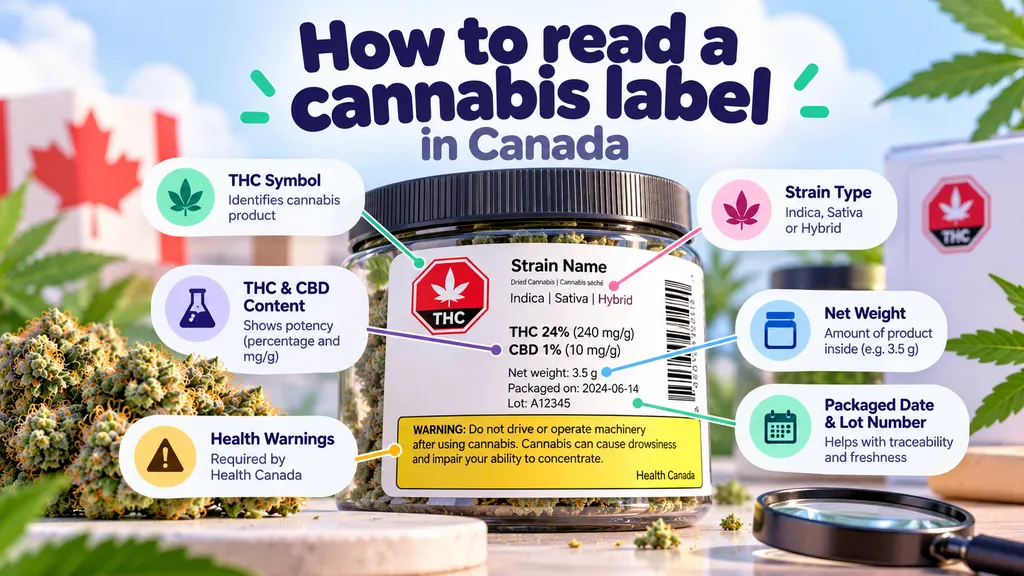
A young woman eating a gummy beside a bowl of colourful gummies and baked treatsGuideHow long do edibles take to kick in?Health Canada says edibles can take 30 minutes to 2 hours to start working, with the strongest effects 2 to 4 hours in and effects lasting 4 to 8 hours. The wait is why the standard advice is to start low, go slow and not take more too early.Read it A Canadian cannabis jar with its label parts called out: the THC symbol, THC and CBD content, net weight, packaged date, lot number and the Health Canada warningGuideHow to read a cannabis label in CanadaEvery legal cannabis product in Canada has to show its Total THC and Total CBD, the red THC symbol, a yellow health warning, a lot number, a packaging date and an excise stamp for your province. Total THC is the number to compare, and it's shown in mg/g for flower and in mg per piece and per package for edibles.Read it A person resting on a couch with a hand on their forehead, next to a water bottle and a bowl of fruitGuideWhat is greening out? Signs and what to doGreening out is a slang term for taking more cannabis than your body handles comfortably, usually with a wave of unpleasant physical and mental effects. It is generally temporary. The usual advice is to stop consuming, get somewhere calm, and call for help if symptoms are severe.Read it A joint, a vape cartridge and gummies, titled How long does a high last? Smoked, vaped and ediblesGuideHow long does a high last? Smoked, vaped and ediblesHealth Canada says that after smoking or vaping you could feel effects for 2 to 4 hours, and after eating or drinking cannabis for 4 to 8 hours. Edibles also start later: within 30 minutes to 2 hours, compared with seconds or minutes when inhaled.Read it Three glass jars of frosty cannabis buds on a wooden counter beside a small digital scale and a glass beakerGuideWhat does the THC percentage on weed actually mean?A THC percentage is a calculated share of a flower's weight, worked out from one lab sample of one lot. It is useful, but it is one value drawn from a plant that varies, and we could not find a source that shows what it predicts about how a product will feel.Read it A healthy green cannabis plant in a pot beside a small clip-on fan, a handheld magnifier and a humidity gauge on a wooden shelfGuideCannabis pests, mould and bud rot: why it starts insideA Canadian government guide says bud rot commonly starts in the interior of the bud, where humidity is highest and air movement is lowest. That makes it an environment problem first. Here is what the sources establish about pests and mould on a growing plant, and where they stay silent.Read it A small magnifying loupe resting beside a young cannabis plant, with a few fresh cuttings and a pair of fine scissors on a wooden benchGuideSexing cannabis plants: pre-flowers and hermiesSexing is the step that decides whether a cannabis plant ever becomes the flower people buy: only unpollinated females do. Pre-flowers at the nodes show the sex, and a hermaphrodite shows both. What pollination costs in potency has not been measured in the sources we could verify.Read it A sample cup and a test cassette beside a mint dish with a frosty cannabis bud, a clipboard and green trailing plantsGuideWeed and drug tests in Canada: what a test can and can't tell youThere is no single number for how long THC stays detectable, and any page that gives one is oversimplifying. In Canada, workplace drug testing is shaped by case law rather than a statute, and it is narrow: individual testing is generally allowed only in specific situations and safety-sensitive roles.Read it